29th March 2026, Gaurav Kumar Singh
A Late-Night Scroll That Sparked a Bigger Question
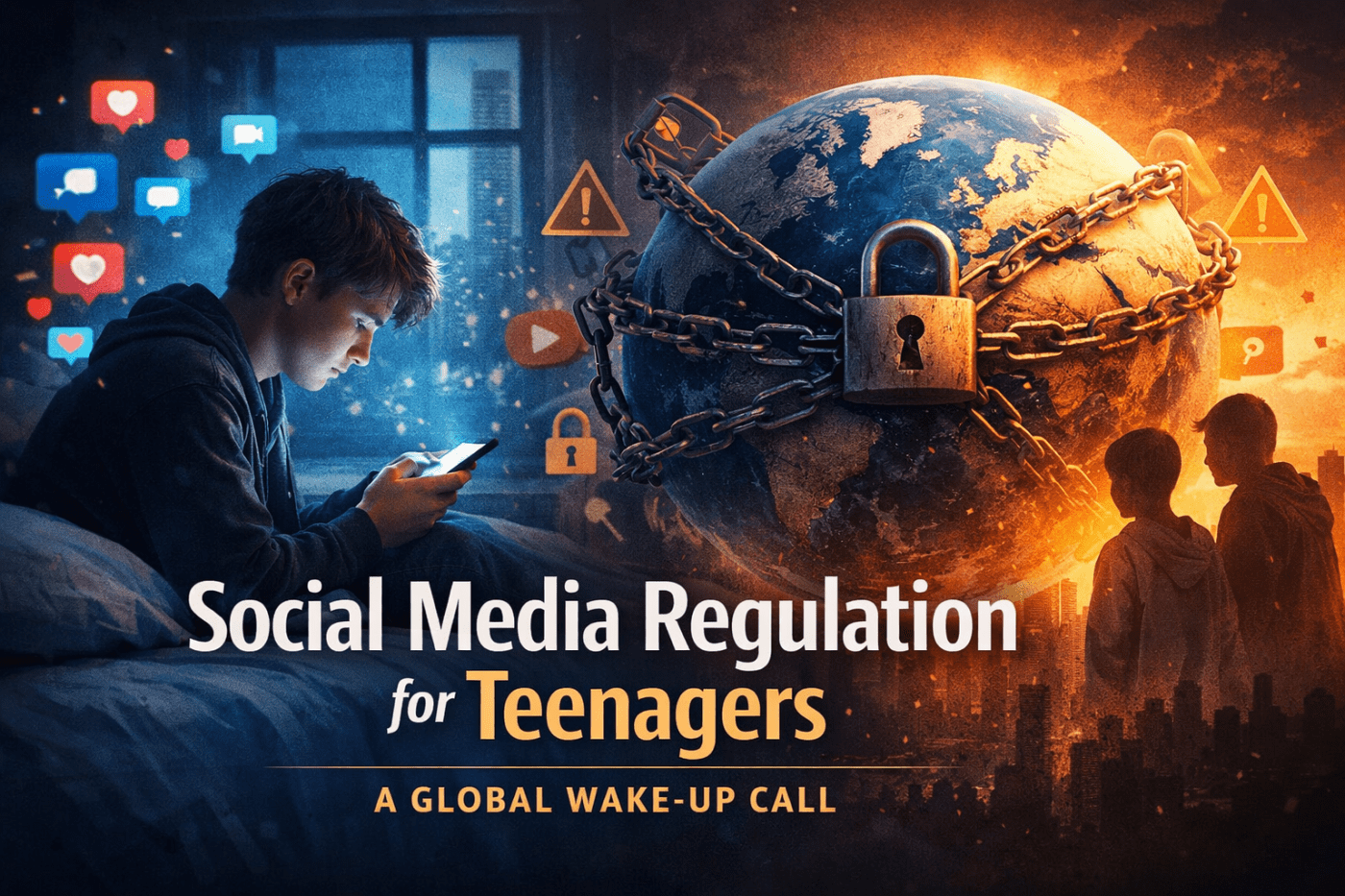
It’s 11:45 PM. A teenager lies in bed, eyes glued to a glowing screen. One video turns into ten, ten into fifty. Notifications keep buzzing. Sleep gets pushed aside. The next morning? Fatigue, irritability, and a mind still stuck in last night’s endless scroll.
Sound familiar?
If you’re a parent, teacher, or even a teen yourself, you’ve likely witnessed this scenario more times than you’d like to admit. And this everyday moment is exactly what has triggered a global conversation: Should social media usage for teenagers be regulated?
Let’s break it down simply, honestly, and with a human lens.
What Does “Social Media Regulation for Teenagers” Actually Mean?
At its core, social media regulation for teenagers refers to laws, policies, or platform rules designed to control how young people access and use social media.
Think of it like traffic signals on a busy road. Without them, chaos is inevitable. With them, movement becomes safer, even if slightly restricted.
Around the world, governments are considering measures like:
* Setting minimum age requirements
* Limiting screen time
* Restricting certain types of content
* Requiring parental consent for accounts
But why now? Why is this becoming such a pressing issue?
The Real Reason Behind the Push: It’s Not Just About Screens
Imagine handing a teenager a powerful tool without instructions. That’s essentially what happened when social media exploded over the past decade.
Initially, it felt harmless, connecting friends, sharing photos, watching videos. But slowly, patterns began to emerge.
The Mental Health Connection
Picture a teenager scrolling through perfectly edited lives, vacations, achievements, flawless selfies. Now compare that to their own messy, imperfect reality.
It’s like constantly being judged in a silent competition.
Studies and reports from organisations like the World Health Organization and UNICEF have highlighted rising concerns about:
* Anxiety and depression
* Low self-esteem
* Cyberbullying
* Sleep disruption
You might be surprised to learn that for many teens, social media isn’t just entertainment, it’s a source of pressure.
How Social Media Hooks Teenagers (And Why It’s Hard to Stop) ?
Let’s simplify this with a relatable analogy.
Think of social media like a slot machine in a casino.
You pull the lever (scroll), and sometimes you get something exciting, a funny video, a like, a comment. Most of the time, it’s average. But that unpredictability keeps you hooked.
Teenagers, whose brains are still developing, are especially vulnerable to this cycle.
Platforms use:
* Infinite scrolling
* Notifications
* Algorithm-driven content
These features are not accidental, they’re designed to keep users engaged.
And when that engagement turns into dependency, concerns naturally rise.
What Different Countries Are Doing About It ?
This isn’t just a discussion, it’s already turning into action.
Imagine different countries as parents in a large household, each trying their own approach to discipline.
Some are strict. Some are cautious. Some are still figuring it out.
Stricter Measures
Countries like Australia and parts of the United States are exploring:
* Age verification systems
* Bans on social media under certain ages
* Stronger parental controls
Balanced Approaches
Nations in Europe are focusing on:
* Data protection laws
* Limiting targeted ads for minors
* Transparency in algorithms
Emerging Conversations
Countries like India are also actively discussing:
* Digital literacy programs
* Screen time awareness
* Platform accountability
It’s like the world collectively realizing: “We gave kids the keys to the digital world, now we need to guide them.”
The Big Debate: Protection vs Freedom
Here’s where things get interesting.
Regulating social media for teenagers isn’t a simple “yes” or “no” decision. It’s more like balancing on a tightrope.
On One Side: Protection
Supporters argue:
* Teens need safeguards, just like seat-belts in cars
* Platforms should be responsible for harmful content
* Mental health must come first
On The Other Side: Freedom
Opponents worry
* Over-regulation may limit creativity and expression
* Teens use social media for learning and connection
* Enforcement could become intrusive
Think of it like teaching a child to ride a bicycle. Too much control, and they never learn balance. Too little, and they risk falling hard.
What This Means for Parents and Teenagers ?
Let’s bring this closer to home.
Imagine a family dinner conversation where instead of arguing about “phone usage,” there’s an understanding of why limits exist.
That’s the real goal of social media regulation for teenagers, not control, but awareness and balance.
For Parents
It’s less about strict bans and more about:
* Open conversations
* Setting realistic boundaries
* Leading by example
For Teenagers
It’s about realizing:
* Not everything online is real
* Your worth isn’t defined by likes
* Taking breaks is not a weakness, it’s smart
The Road Ahead: What the Future Might Look Like?
If current trends continue, the future of social media for teenagers could look very different.
Imagine logging into a platform that:
* Automatically limits usage after a certain time
* Filters harmful content more effectively
* Encourages meaningful interactions over endless scrolling
Sounds ideal, right?
But achieving this requires collaboration between:
* Governments
* Tech companies
* Parents
* Teenagers themselves
Because regulation alone won’t solve the problem, mindset will.
Final Thoughts: Finding Balance in a Digital World
At the heart of this global conversation lies a simple truth:
Social media isn’t inherently good or bad, it’s how it’s used that matters.
Regulating social media for teenagers is not about taking something away. It’s about giving them a safer, healthier environment to grow in.
So the next time you see a teenager scrolling late at night, pause for a moment.
Instead of asking, “Why are they always on their phone?”, maybe the better question is:
“How can we help them use it better?”
Call to Action
What do you think?
Should governments strictly regulate social media for teenagers, or should families take the lead?
Share your thoughts in the comments. If this article made you think differently, pass it on, it might help someone else see the bigger picture too.

If you found this article valuable, please don’t forget to Like and Subscribe to my blog for more expert insights and updates.
 THE MIND UPGRADE
Leave a comment