26th March 2026, Gaurav Kumar Singh
A Familiar Confusion We All Share
It’s early morning. You wake up, check your phone, and see messages flooding in—“Happy Janmashtami!”
But wait… your calendar says it’s tomorrow.
You ask your family WhatsApp group, and suddenly there are two camps—one celebrating today, the other tomorrow. Someone confidently says, “Today is correct according to our Panchang.” Another replies, “No, tomorrow is the proper date!”
And just like that, a festival becomes a debate.
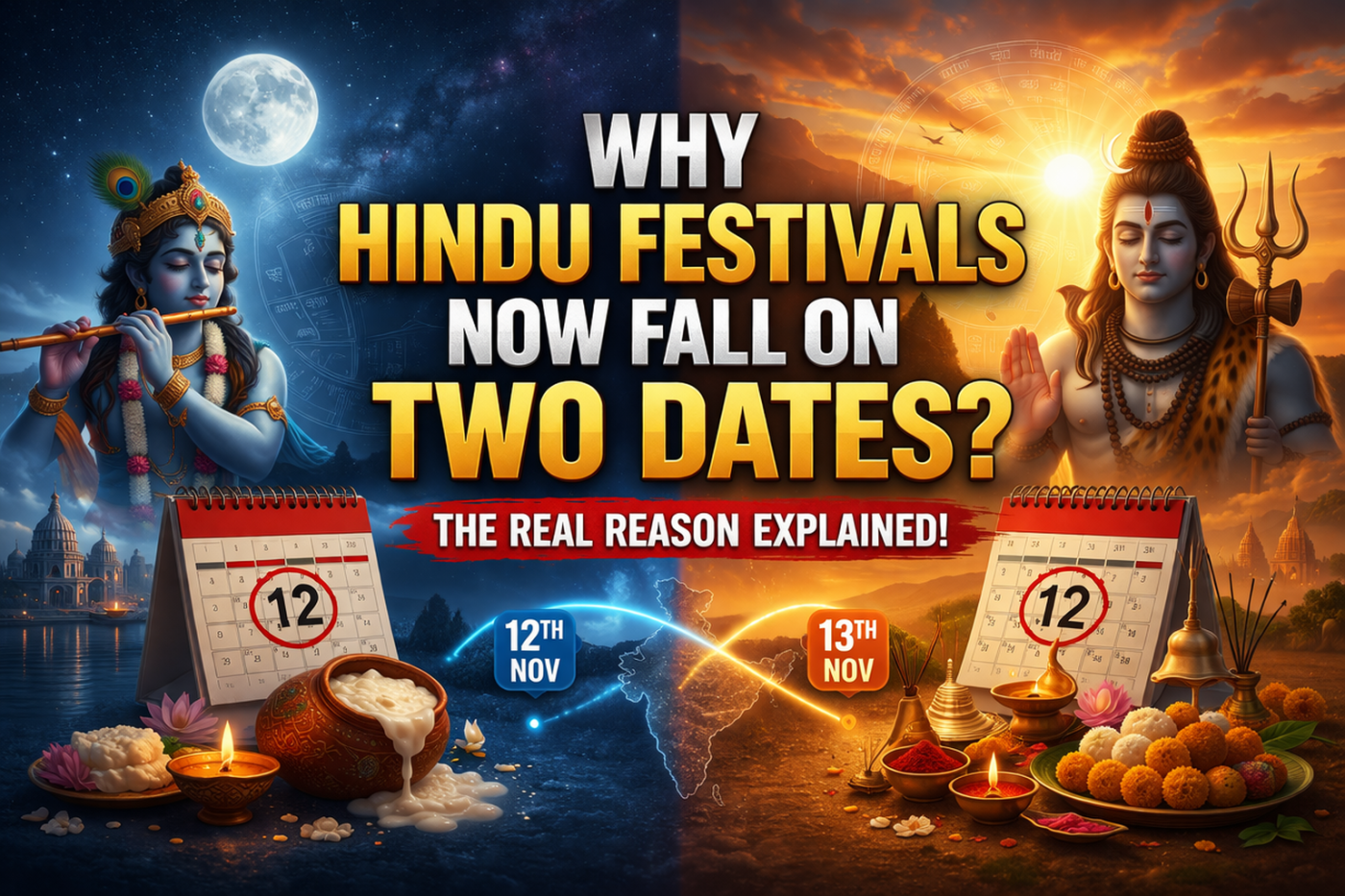
If you’ve experienced this (and let’s be honest—you probably have), you’re not alone. The question naturally arises: Why Hindu festivals now fall on two dates?
Let’s unravel this—simply, clearly, and without the confusion.
The Short Answer (For Quick Understanding)
Hindu festivals are based on the lunar calendar (moon cycles), not the fixed solar calendar (like January–December).
Because festival dates depend on tithi (lunar day) and its timing (which can start or end at any time of the day), different interpretations lead to different celebration dates.
Both dates can actually be correct—depending on the rule being followed.
Now let’s understand this like a story.
The Heart of the System: What Is a Tithi?
Imagine you’re watching the moon every night. It grows, shrinks, disappears, and reappears. Ancient Indian scholars didn’t just admire it—they measured time with it.
A tithi is not a regular 24-hour day. Instead, it’s based on the angular distance between the Sun and the Moon.
Think of it like this:
You and your friend are walking on a circular track at different speeds. The distance between you keeps changing. Every time that distance increases by a fixed amount, a new “tithi” begins.
Because of this:
* A tithi can be shorter than 24 hours
* Or longer than 24 hours
* It can start at 2 PM, end at 11 AM next day, or any odd time
Now imagine planning a festival based on something so fluid!
Sunrise Rule vs Midnight Rule: Where the Split Happens
Here’s where things get interesting—and a bit controversial.
Different traditions follow different rules to decide which day to celebrate.
1. The Sunrise Rule (Traditional Approach)
Most Hindu traditions say:
The festival should be observed on the day when the tithi is present at sunrise.
Think of sunrise as the “official start” of the day in traditional Indian timekeeping.
So if a tithi exists at sunrise—even if it started late the previous night—that day is chosen.
2. The Midnight or Nishita Rule (Event-Based Approach)
Some festivals are linked to a specific time of day, not sunrise.
For example:
* Janmashtami celebrates the birth of Lord Krishna at midnight
* Mahashivratri is observed at night
In such cases, the festival is celebrated on the day when the tithi is present during that specific time window.
A Real-Life Analogy: Two People, One Birthday
Imagine this:
A baby is born at 11:50 PM on August 10.
Now:
One person says, “The birthday is August 10” Another says, “Most of the celebration happens on August 11”
Who is right?
Both are.
This is exactly what happens with Hindu festivals.
One group prioritizes when the tithi starts, another prioritizes when the key moment occurs.
Why This Confusion Feels Worse “Nowadays”
You might be thinking:
“But earlier, we didn’t have this confusion so often!”
You’re right—and here’s why.
1. Earlier, We Followed One Local Panchang
In the past, communities followed a single local calendar (Panchang).
There was no internet, no multiple sources, no debates.
Everyone simply followed what the local priest or temple said.
2. Today, We Have Multiple Panchangs
Now we have:
* North Indian Panchang
* South Indian Panchang
* ISKCON calendars
* Regional temple traditions
Each may apply slightly different rules.
3. Social Media Amplifies Differences
Earlier, differences stayed local.
Today, one WhatsApp forward from another city can make you question your own tradition.
Suddenly, what was once quiet diversity becomes visible confusion.
The Role of Astronomy (Yes, It’s Actually Scientific!)
Here’s something you might find surprising:
Hindu calendar calculations are deeply astronomical, not arbitrary.
Ancient scholars used precise observations of:
* Moon phases
* Solar positions
* Planetary movements
But here’s the catch—modern astronomical precision has actually made calculations more exact, which sometimes leads to more visible differences between systems.
It’s like having multiple high-precision clocks that differ by a few seconds—earlier you wouldn’t notice, now you do.
Is One Date Right and the Other Wrong?
Let’s be clear:
No.
Both dates usually follow valid but different rules.
It’s not about right vs wrong—it’s about which tradition you follow.
Think of it like language:
+ Some say “tomato”
* Others say “tomaato”
Same meaning, different expression.
So, What Should You Do?
Here’s a practical and peaceful approach:
Follow one trusted source consistently:
* Your family tradition
* Your local temple
* A specific Panchang
The real essence of festivals is devotion, not debate.
After all, no deity is keeping score saying, “You celebrated 12 hours late!”
Looking Ahead: Will This Continue?
Most likely, yes.
As long as:
* Lunar calculations exist
* Traditions vary
* People interpret rules differently
…this dual-date situation will remain.
But instead of seeing it as confusion, we can see it as something beautiful:
A living tradition, still evolving, still adapting.
Final Thoughts: It’s Not Confusion, It’s Diversity
Next time you see two dates for a festival, don’t get frustrated.
Pause and think:
“This is thousands of years of astronomy, tradition, and culture at work.”
What looks like confusion is actually rich diversity in practice.
And maybe—that’s what makes Hindu traditions so unique.
Your Turn
Have you ever celebrated a festival on the “wrong” date and later found out there was another one?
Or do you strictly follow one calendar?
Share your experience—I’d love to hear how you and your family handle this yearly puzzle.

If you found this article valuable, please don’t forget to Like and Subscribe to my blog for more expert insights and updates.

 THE MIND UPGRADE
Leave a comment