25th March 2026, Gaurav Kumar Singh
A Small Moment That’s About to Change…
Imagine this.
It’s June 2026. You’re sitting with a cup of tea, opening your email, waiting for that familiar document—Form 16. For years, it’s been your starting point for filing income tax. Almost like a yearly ritual.
But this time… it’s not there.
Instead, you see something new—Form 130.
You pause.
“What is this? Did I miss something?”
You didn’t. The system changed.
Quick Answer: What’s Changing in Income Tax Filing from April 2026?
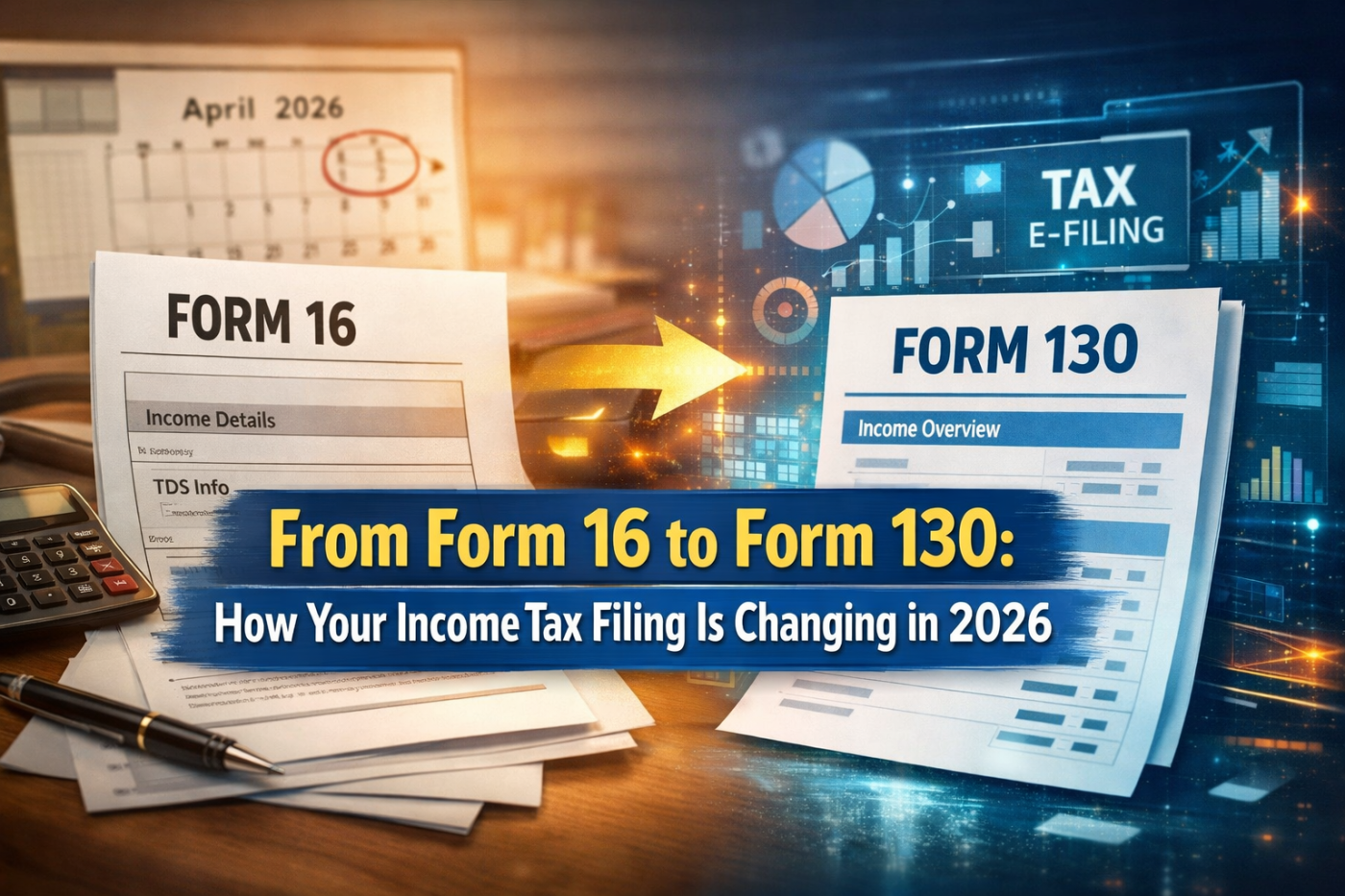
From April 1, 2026, the government is introducing new ITR forms and replacing Form 16 with Form 130, aiming to simplify tax filing, improve transparency, and reduce errors through better pre-filled data and reporting systems.
Why Is the Government Changing the Tax Filing System?
Think of tax filing like assembling a puzzle.
Earlier, you had all the pieces—but no clear picture. Form 16 gave you a summary, but you still had to figure out the full story.
Now, the government is trying to give you a nearly completed puzzle, where most pieces are already placed.
The goal is simple:
* Less confusion
* Fewer mistakes
* Faster filing
The End of Form 16: Why Form 130 Is Taking Its Place?
Form 16 has been like your yearly report card—issued by your employer, summarizing your salary and tax deducted.
But here’s the limitation:
It depended heavily on what your employer reported.
Now imagine a report card created not just by your teacher—but also verified by the education board.
That’s what Form 130 aims to be.
It is expected to:
* Pull data from multiple verified sources
* Align directly with tax department systems
* Reduce dependency on employer-only data
* Provide a more complete financial picture
Form 16 vs Form 130: What’s the Real Difference?
Let’s break this down in a way that actually makes sense.
Think of Form 16 as a summary written by your employer, while Form 130 is more like a system-generated financial snapshot created with cross-verified data.
The core difference lies in who controls the information
With Form 16, your employer played the central role.
With Form 130, the system itself becomes the source of truth.
Here’s how that changes your experience
In the past, if your employer made a small mistake in Form 16, it could create confusion while filing returns. You might have had to recheck payslips, deductions, or even contact HR.
With Form 130, the idea is to reduce such back-and-forth.
It’s like the difference between:
* A handwritten bill at a local shop.
* A computer-generated invoice linked to inventory and billing systems.
Both give you information—but one is far more reliable and consistent.
What you’ll actually notice as a taxpayer
When you receive Form 130:
* It may already include more comprehensive income details.
* It will likely match closely with AIS and tax portal data.
* You may spend less time correcting mismatches
But—and this is important—you should never assume it’s perfect.
Even the best systems need human verification.
New ITR Forms: Simpler or More Complex?
Imagine booking a train ticket today versus 10 years ago.
Earlier, you filled everything manually.
Now, most details are auto-filled.
That’s exactly what the new ITR forms aim to do.
They are designed to:
* Pre-fill your financial data
* Reduce manual entry
* Improve accuracy
But just like booking a ticket—you still check the details before confirming, right?
Same rule applies here.
What This Means for Salaried Employees?
Earlier, your tax filing depended heavily on:
* Form 16
* Manual data entry
* Personal calculations
Now, things are shifting toward:
* Automated data
* System-based reporting
* Verification rather than calculation
A simple way to understand this shift
Earlier, you were doing the math yourself.
Now, the system does the math—you just verify the answer.
Benefits of These Changes
This shift brings some clear advantages.
You’ll likely experience less manual work, better accuracy, and faster filing. It may also reduce the chances of receiving tax notices due to mismatches.
Think of it like switching from cash bookkeeping to digital accounting—cleaner, faster, and more reliable.
Possible Challenges You Should Be Ready For
But let’s be real—no change is completely smooth.
Initially, there may be confusion around new formats. Some taxpayers might rely too much on pre-filled data without checking it properly. And yes, there could be technical glitches in the early phase.
It’s like getting a new smartphone—you know it’s better, but it takes a few days to get used to it.
How You Can Prepare for Income Tax Filing Changes 2026?
Preparation is your biggest advantage.
Start keeping your own records of income and investments. Regularly check AIS and tax statements. And most importantly—stay informed.
Because even in a smarter system, awareness is your safety net.
The Bigger Picture: Where Is Tax Filing Heading?
This is not just a form change.
It’s a shift toward a fully digital tax ecosystem where:
* Data is interconnected
* Filing is faster
* Errors are minimized
Think of it like moving from offline banking to net banking—and eventually to UPI.
Final Thoughts: Change Feels Uncomfortable… Until It Doesn’t
At first, replacing Form 16 may feel like losing something familiar.
But over time, Form 130 could actually make your life easier.
Because the goal isn’t to complicate things—it’s to make tax filing smarter and more reliable.
Your Next Step
Don’t wait for June panic.
Start preparing now.
Review your finances, stay updated, and approach this change with clarity—not confusion.
Over to You
Do you think Form 130 will make tax filing easier—or add more complexity in the beginning?
Drop your thoughts in the comments—I’d genuinely love to hear your take.

If you found this article valuable, please don’t forget to Like and Subscribe to my blog for more expert insights and updates.

 THE MIND UPGRADE
Leave a comment