16th March 2026, Gaurav Kumar Singh
A Curious Experiment That Revealed Something Deep About Human Nature
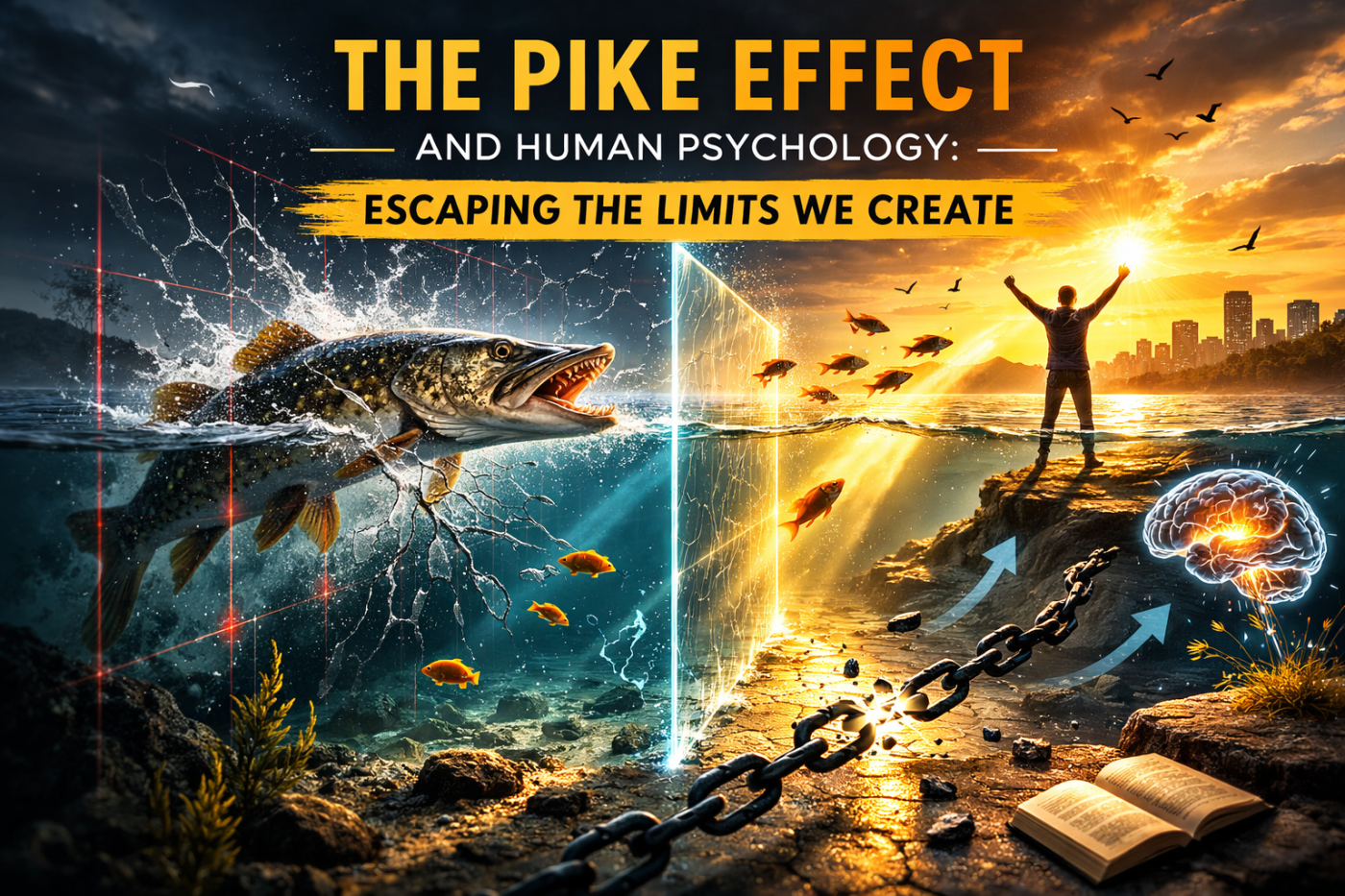
Imagine standing in front of a large aquarium. Inside, a fast and aggressive predatory fish called a pike swims confidently through the water. On the other side of the tank, small bait fish move nervously, unaware of what might happen next.
Now imagine something interesting.
A transparent glass barrier separates them.
The pike sees the bait fish and immediately attacks, just as nature programmed it to do. But instead of catching its prey, the pike crashes into the invisible glass wall. Again and again it tries, and again and again it fails.
Eventually, something remarkable happens.
The pike stops trying.
Even after the glass barrier is removed, the pike refuses to attack the bait fish. It swims around them peacefully, as if the invisible wall still exists.
This simple but powerful observation is known as the Pike Effect, and it offers a profound insight into human psychology.
What Is the Pike Effect?
The Pike Effect refers to a psychological phenomenon where repeated failure or negative experience conditions an individual to stop trying—even when the barrier to success is later removed.
In other words:
After experiencing failure enough times, people may believe success is impossible—even when it actually becomes achievable.
This concept is closely related to the idea of learned helplessness, a term widely discussed in behavioral psychology.
Think of it like this: your mind creates an invisible glass wall, just like the one in the fish tank.
The Original Pike Experiment: A Story of Conditioning
Let’s go back to the aquarium for a moment.
The pike was naturally designed to hunt. It had speed, instinct, and opportunity. Yet something changed its behavior dramatically.
Each time the fish tried to catch the bait, it experienced pain and failure.
Over time, the pike’s brain learned a simple rule:
“Attacking these fish leads to pain.”
Eventually, the pike stopped attempting to hunt them altogether.
Even when the barrier disappeared, the memory of failure remained stronger than the new reality.
This experiment revealed something scientists have long suspected:
Past experiences strongly influence future behaviour, even when circumstances change.
Now here’s the fascinating part.
Humans often behave exactly the same way.
The Pike Effect in Everyday Life
You might be surprised to realize how often the Pike Effect shows up in daily life.
Consider a child learning mathematics in school.
At first, the child tries to solve problems enthusiastically. But after repeated mistakes, scolding, or embarrassment in class, something changes. Slowly the child begins to think:
“I’m just bad at math.”
Years later, the student avoids math completely—even if the opportunity to learn in a supportive environment appears.
The glass barrier no longer exists, but the belief remains.
This happens in many areas of life:
* A professional stops applying for promotions after a few rejections.
* An entrepreneur stops trying new business ideas after one failed startup.
* Someone stops exercising after repeated unsuccessful attempts to lose weight.
In each case, the person isn’t limited by reality.
They are limited by memory and belief.
Why the Pike Effect Happens: The Psychology Behind It
Our brains are incredibly efficient learning machines.
They constantly look for patterns to help us survive and avoid danger.
When a negative experience repeats several times, the brain forms a protective shortcut.
Think of it like touching a hot stove as a child.
After that painful experience, your brain immediately warns you to stay away. That protective mechanism is extremely useful for survival.
But sometimes the brain applies the same logic where it doesn’t belong.
Instead of protecting us from danger, it starts protecting us from possibility.
In psychology, this mechanism is related to learned helplessness, a concept studied extensively by psychologist Martin Seligman.
His research showed that when individuals repeatedly experience situations where their actions don’t change outcomes, they may stop trying altogether—even when control later becomes possible.
Just like the pike in the aquarium.
The Hidden Cost of the Pike Effect
The most dangerous part of the Pike Effect is that it often works silently.
People rarely say:
“I stopped trying because of psychological conditioning.”
Instead, they say things like:
“I’m not talented enough.”
“That’s just not for people like me.”
“I tried before. It didn’t work.”
But if you look closely, these beliefs often come from old experiences that no longer reflect current reality.
Think of someone who failed a public speaking attempt in school.
Years later, they avoid leadership roles because they believe they are bad speakers.
Yet if they tried again today—with experience, maturity, and training—they might perform brilliantly.
But the invisible glass wall still exists in their mind.
Breaking the Pike Effect: Escaping Invisible Limits
The good news is that the Pike Effect is not permanent.
Unlike the fish in the aquarium, humans have the ability to reflect on their own thinking.
One of the most powerful ways to break this mental barrier is simply awareness.
When you recognize that past failure may be influencing present decisions, something powerful happens.
You begin to question the invisible wall.
Think of learning to ride a bicycle as a child. The first few attempts often end with scraped knees and frustration. But imagine if you stopped after the third fall.
You would never discover that balance comes only after repeated attempts.
The same principle applies to careers, learning, creativity, and personal growth.
Each new attempt weakens the imaginary barrier created by past failure.
A Powerful Lesson for Education, Leadership, and Parenting
The Pike Effect also carries an important message for teachers, managers, and parents.
People often underestimate how strongly early experiences shape long-term behavior.
A teacher who labels a student as “weak in science” may unintentionally create a mental barrier that lasts for years.
Similarly, workplaces that punish mistakes harshly may unknowingly discourage innovation.
Imagine a workplace aquarium where every attempt leads to criticism.
Soon, employees stop trying new ideas entirely.
Not because they lack creativity.
But because the glass wall of past experience is still there.
Great leaders and educators understand this and create environments where failure becomes a step toward learning rather than a signal to stop trying.
The Future Perspective: Why Understanding the Pike Effect Matters
In today’s fast-changing world, the ability to adapt and learn continuously is more important than ever.
Technology evolves rapidly, industries transform, and new opportunities appear every year.
But the biggest obstacle to growth is often not skill, resources, or intelligence.
It is psychological conditioning from past failure.
Understanding the Pike Effect reminds us of something powerful:
The barriers that limit us most are often invisible.
Once we question them, they begin to lose their power.
And sometimes, all it takes is one new attempt to realize that the glass wall was removed long ago.
Conclusion: Are You Swimming Inside an Invisible Tank?
The story of the pike and the bait fish may seem simple, almost like a small scientific curiosity.
But its lesson is profound.
Many of us swim through life believing certain opportunities are unreachable—when in reality, the barrier disappeared long ago.
The real question is not whether the glass wall exists.
The real question is whether we are brave enough to test it again.
So the next time you hesitate because of past failure, pause for a moment and ask yourself:
Is this a real barrier… or just the Pike Effect?
If this article made you think differently about failure, mindset, or personal growth, share it with someone who might be living inside an invisible glass tank.
You never know whose perspective it might change.

If you found this article valuable, please don’t forget to Like and Subscribe to my blog for more expert insights and updates.

 THE MIND UPGRADE
Leave a comment