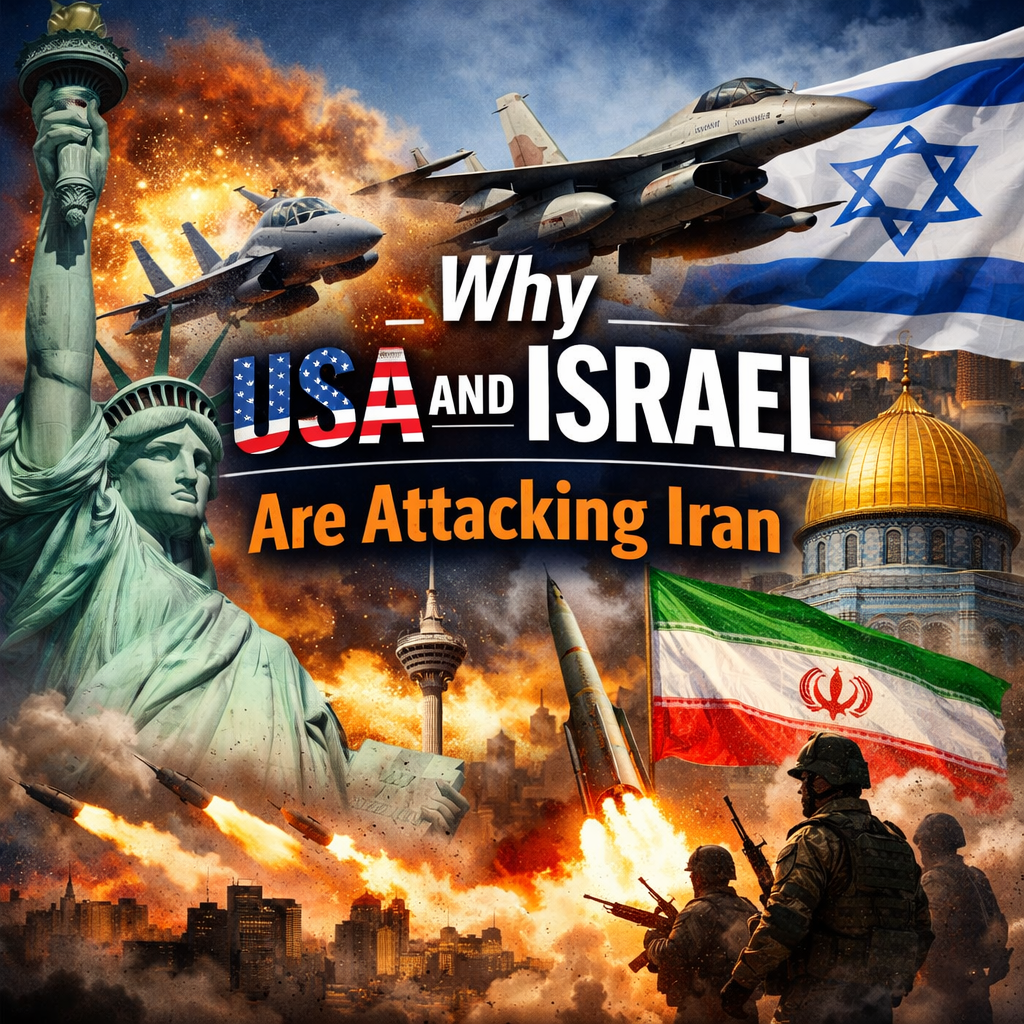
6th March 2026, Gaurav Kumar Singh
Imagine waking up one morning, reaching for your phone, and seeing the headline: “USA and Israel launch major military strikes on Iran. Supreme Leader Khamenei killed.” For a second, you rub your eyes. You check a second source, then a third. It’s real. The Middle East — already a region the world has watched nervously for decades — has just been turned upside down.
That is precisely what happened on February 28, 2026.
If you found yourself staring at that news, jaw dropped, thinking “How did we get here?” — you are not alone. Millions of people around the world had the exact same reaction. The strikes felt sudden. But here is the thing: they were anything but sudden. This was the boiling point of a pot that had been heating up for over four decades.
So let’s slow down, take a breath, and walk through the whole story — from the very beginning — in a way that makes complete sense, even if you have never followed Middle Eastern politics a day in your life.
The Quick Answer: Why Did the USA and Israel Attack Iran?
Before we dive into the full story, here is the short version for those of you who want the snapshot: The United States and Israel launched coordinated military strikes on Iran primarily to destroy Iran’s nuclear program — which both countries feared was edging dangerously close to producing a nuclear weapon — and to force a change in Iran’s government (what politicians call “regime change”). The strikes came after months of failed diplomacy, a massive US military buildup in the region, and growing fears that Iran was rapidly advancing its nuclear capabilities despite ongoing negotiations.
Now, if you want to truly understand “why”that matters and “how” we got there, keep reading. The real story is far more fascinating — and frankly, more alarming — than any headline can capture.
Two Countries That Were Once Friends
Here is a detail that surprises most people: Israel and Iran were not always enemies. In fact, for much of the 20th century, they maintained warm, cooperative relations. Iran under its monarch, Shah Mohammad Reza Pahlavi, was a modernising, pro-Western state. Israel and Iran shared intelligence, traded together, and even had unofficial diplomatic ties. The United States, meanwhile, was deeply invested in Iran as a strategic ally in the oil-rich Middle East.
Think of it like two neighbours who used to lend each other tools and share meals. There was a time when that friendship seemed perfectly natural.
Then came 1979. And everything changed.
The Iranian Revolution of 1979 swept away the Shah and replaced him with a radically different kind of government — a theocracy led by Ayatollah Ruhollah Khomeini. The new Islamic Republic declared the United States the “Great Satan” and Israel a colonial oppressor that had no right to exist. Overnight, those once-cooperative neighbours became bitter, ideological foes. American diplomats were taken hostage in Tehran for 444 days. The United States imposed crippling sanctions. And Israel found itself facing a government that openly called for its destruction.
That is the historical earthquake that set everything else in motion.
Iran’s Nuclear Programme: The Heart of the Problem
Fast forward to the early 2000s. The world is already nervous about weapons of mass destruction — this is the era of the Iraq War, of fears about rogue states, of a world reshaped by the September 11 attacks. And then, in 2002, a shocking revelation: Iran had secretly been building nuclear facilities that it had never disclosed to international inspectors.
Now, Iran maintained — and has continued to maintain to this day — that its nuclear programme is entirely peaceful. It says it wants nuclear energy, not nuclear weapons. And to be fair, the International Atomic Energy Agency (IAEA), the global nuclear watchdog, has stated that there is no definitive proof Iran has built or is actively building an atomic bomb.
But here is where it gets complicated, and where you have to think like a geopolitical chess player rather than someone taking everything at face value. Iran has, over the years, enriched uranium to levels far higher than what you need for civilian electricity generation.
Think of it this way: if you are baking a cake, you need a specific amount of flour. If someone is buying ten times the amount of flour they could possibly need for baking, you start to wonder what they are really making. Enriching uranium to 60 percent purity — which Iran was caught doing — is not needed to power a city’s lights. It is, however, suspiciously close to weapons-grade material.
For Israel, a country roughly the size of New Jersey surrounded by neighbours who have historically sought its destruction, the idea of Iran — a government that chants “Death to Israel” in its parliament — possessing a nuclear weapon is not an abstract geopolitical concern. It is an existential threat. An Iranian nuclear bomb, in Israel’s view, would not be a bargaining chip. It would be an annihilation button.
The United States shares a version of this concern, though from a greater distance. A nuclear-armed Iran would upend the entire regional balance of power, potentially spark a nuclear arms race across the Middle East, and give Tehran a shield of invincibility from which to project its influence even more aggressively.
The Iran Nuclear Deal — and How It Fell Apart?
In 2015, the world tried the diplomatic route. After years of painstaking negotiations involving the United States, United Kingdom, France, Germany, Russia, and China — a group known as the P5+1 — Iran signed a landmark agreement called the Joint Comprehensive Plan of Action, or JCPOA. Most people just called it “the Iran nuclear deal.”
The deal was essentially a bargain. Iran agreed to dramatically scale back its nuclear programme — reducing its stockpile of enriched uranium, cutting its number of spinning centrifuges (the machines used to enrich uranium), and opening its facilities to international inspectors. In return, crippling economic sanctions on Iran were lifted, unlocking tens of billions of dollars in frozen Iranian assets and allowing Iran to re-enter the global economy.
It was an imperfect deal, and everyone knew it. Critics — especially in Israel — pointed out that it did not address Iran’s ballistic missile programme (the rockets that could deliver a nuclear warhead) and did nothing to curb Iran’s funding of armed militia groups across the Middle East. The deal also had “sunset clauses,” meaning that many of its restrictions would expire after 10 to 15 years, after which Iran could theoretically resume its nuclear ambitions without penalty.
Then, in 2018, President Donald Trump pulled the United States out of the JCPOA entirely. He called it “the worst deal ever negotiated” and launched what his administration called a “maximum pressure campaign” — essentially an economic stranglehold designed to force Iran back to the negotiating table and agree to a tougher, more comprehensive deal.
Iran’s economy was devastated. The Iranian rial, its currency, plummeted. Ordinary Iranians suffered enormously. But Iran did not fold. Instead, its hardliners grew stronger, and Iran began rapidly expanding its nuclear programme, enriching uranium to ever-higher levels, installing faster and more advanced centrifuges, and eventually barring international inspectors from certain sites.
The diplomatic road was rapidly narrowing into a dead end.
Iran’s “Axis of Resistance”: The Neighbourhood Bully Network
To understand why Israel has felt increasingly under siege, you need to understand a concept called the Axis of Resistance. This is Iran’s strategic network of armed groups and allied governments spread across the Middle East — a kind of geopolitical franchise of militias loyal to Tehran.
Think of it like a spider at the centre of a web. The spider — Iran — sits in Tehran, directing, funding, arming, and training these groups across the region. The threads of the web reach into Lebanon, where Hezbollah is arguably the most powerful non-state military force on earth, boasting over a hundred thousand rockets. They reach into Yemen, where the Houthi movement controls large parts of the country and has spent years firing missiles at Saudi Arabia and, more recently, targeting commercial shipping in the Red Sea.
The web also stretches into Iraq and Syria, where dozens of Iran-backed militias operate. And for years, it stretched into Gaza, where Hamas — despite being a Sunni Palestinian group with some ideological differences from Shia Iran — received Iranian weapons, money, and training.
For Israel, this network meant being surrounded. Not by Iran directly, but by Iran’s proxies — armed groups that could attack from multiple directions simultaneously. Israel’s leaders repeatedly described it as “a ring of fire” being built around them.
This is also why the October 7, 2023 Hamas attack on Israel — the deadliest attack on Jewish people since the Holocaust, killing approximately 1,200 people — was so deeply connected to the Iran picture. Hamas is part of Iran’s axis. The weapons Hamas used, the training its fighters received — much of it traces back to Iranian support. Iran did not order the October 7 attack, by most accounts, but it had spent years building the capacity that made it possible.
The Dominoes Begin to Fall: 2023–2025
After October 7, 2023, the Middle East entered a period of extraordinary upheaval. Israel launched a major military campaign in Gaza. Iran-backed groups across the region ramped up attacks on US military bases in Iraq and Syria — more than 200 attacks in the months after October 2023. Hezbollah and Israel traded fire across Lebanon’s border. The Houthis began attacking commercial shipping lanes in the Red Sea, one of the world’s most vital trade routes, disrupting global supply chains and forcing major shipping companies to reroute around Africa.
Then Israel began dismantling Iran’s proxy network with a focus and precision that stunned observers. In late 2024, Israel eliminated the top leadership of Hezbollah, including its long-time chief Hassan Nasrallah. Israel struck Hamas leadership throughout the year. And in December 2024, Syria’s President Bashar al-Assad — a key Iranian ally who had allowed Iran to use Syrian territory as a corridor for weapons — was toppled by rebel forces.
Iran responded in April and October 2024 by launching direct missile and drone attacks on Israel — a historic escalation. It was the first time Iran had directly struck Israel from its own soil, stepping away from its usual strategy of fighting through proxies. Both attacks were largely intercepted, though they revealed Iran’s vulnerabilities. Iran’s missiles simply could not penetrate Israel’s sophisticated layered air defence system, made up of Iron Dome, David’s Sling, and the Arrow systems — all operating with real-time US assistance.
Then came June 2025. Israel launched a major unilateral strike on Iran’s nuclear facilities and military infrastructure. The United States joined the operation weeks later, striking Iran’s key nuclear sites at Natanz, Fordow, and Isfahan. A ceasefire was eventually brokered, but the damage was done — and crucially, not finished.
By the end of 2025, Iran’s once-formidable Axis of Resistance was in tatters. Hezbollah had been decapitated. Hamas was shattered. Assad was gone. The Houthis were weakened. Iran was internationally isolated, economically crippled, and politically weakened by massive domestic protests — hundreds of thousands of Iranians took to the streets in late 2025 and early 2026, furious at the government’s mismanagement, the collapsing economy, and decades of repression. The regime met the protests with lethal force.
Iran had never looked weaker in its 45-year history.
The Final Diplomatic Attempt — and Its Failure
When Donald Trump returned to the White House in January 2025, he restored his maximum pressure policy against Iran while simultaneously opening a back channel for nuclear negotiations. Three rounds of indirect talks took place in Geneva between February and late February 2026, mediated by Oman. Iran’s foreign minister called a deal “within reach.” There was a brief flicker of hope.
But the gaps were enormous. The United States demanded a permanent end to all uranium enrichment. Iran refused to accept any limits on its ballistic missile programme or its support for proxy groups — calling these absolute “red lines” that could not be negotiated. Trump issued a 10-day deadline on February 20, 2026. The third round of talks, on February 26, ended without a breakthrough. Two days later, on February 28, the bombs began falling.
It was a decision made at a precise moment of strategic calculation. Iran was at its weakest. Its allies had been destroyed. Its air defences had been proven porous. Its own people were rising up. And its nuclear programme — despite the June 2025 strikes — had reportedly restarted, with the IAEA announcing on February 27 that inspectors had discovered hidden, highly enriched uranium in an underground facility that had survived previous strikes. The window, Israeli officials argued, would not stay open forever.
What Happened on February 28, 2026?
The scope of the strikes was staggering. A US armada of two aircraft carrier strike groups, dozens of advanced aircraft, and Israeli air force jets launched a sustained, coordinated assault on Iran. Targets included nuclear facilities, missile production sites, naval installations, military headquarters, and the fortified compounds of Iran’s top leadership.
In the early hours of March 1, Iranian state media confirmed what the world had already suspected: Supreme Leader Ayatollah Ali Khamenei — who had ruled Iran for 34 years — had been killed in an Israeli airstrike on his compound. Several top military commanders and nuclear scientists were also killed. President Trump, in a video message broadcast into Iran, addressed the Iranian people directly, telling them their country would “be yours to take” — a clear signal that the operation’s goal was not just nuclear disarmament, but the end of the Islamic Republic itself.
Iran retaliated swiftly and with significant force, firing ballistic missiles at Israel, targeting US military bases across the Gulf states, and striking the US Embassy in Saudi Arabia. Israel simultaneously launched strikes on Beirut to counter Hezbollah. Airspace across the Gulf was closed. Flights were cancelled worldwide. Oil prices spiked sharply. The global economy shuddered.
Trump predicted the conflict could last “four weeks.” The chairman of the US Joint Chiefs of Staff told Congress that more American losses should be expected. As of this writing, the conflict continues, the region is on edge, and the full consequences are yet to unfold.
Why Now? The Perfect Storm of Factors
If you are still asking yourself why this happened at this precise moment in 2026, rather than sooner or later, the answer lies in the convergence of several extraordinary circumstances.
Iran’s defences and regional alliances had been systematically weakened over the previous two years. Israeli and American intelligence had determined that Iran’s nuclear programme, even after the June 2025 strikes, had recovered and was still advancing. The IAEA’s February 27 discovery of hidden enriched uranium shattered whatever remained of diplomatic credibility.
Domestically, Iran’s regime was facing its most serious popular uprising in years, suggesting that a decisive blow might hasten its collapse rather than unite Iranians behind it. And crucially, both the Trump administration and Netanyahu’s Israeli government — each facing domestic political pressures of their own — calculated that this was the best window of opportunity they were likely to have.
What Does the World Think?
Not everyone is applauding. The reactions from the international community have been sharply divided. NATO Secretary General Mark Rutte expressed European “support” for the strikes, framing Iran as a regional threat. The European Union Commission expressed support for regime change in Iran. But Gulf Arab states — including Saudi Arabia, UAE, Qatar, Kuwait, Oman, and Bahrain — condemned Iran’s retaliatory strikes on their territory while also, in several cases, criticising the US-Israel action as destabilising. Oman, which had been the diplomatic mediator, was particularly critical.
Russia condemned the strikes as an “unprovoked act of armed aggression” and declared them a violation of international norms — though analysts note that Russian condemnation is unlikely to translate into meaningful military action, particularly given Russia’s preoccupation with Ukraine. China urged calm. Much of the Global South expressed deep discomfort with the unilateral use of military force.
What Happens Next? The Uncertain Road Ahead
The burning question on every analyst’s mind is: what comes after? Killing Khamenei is not the same as killing the Islamic Republic. Iran’s Revolutionary Guards, its sprawling religious bureaucracy, its economic networks, and its armed forces will not simply evaporate. History has shown, repeatedly, that decapitating a regime creates a dangerous power vacuum that armed factions rush to fill — often violently.
There is also the serious question of what a chaotic, post-regime Iran would look like. Would a democratic transition emerge? Would rival factions plunge the country into civil war? Would another authoritarian system fill the void? These are not rhetorical questions — they are the questions that will define the next chapter of Middle Eastern history, and quite possibly, global history.
What is certain is this: the Iran that emerges from this conflict — whatever form it takes — will be fundamentally different from the one that existed before February 28, 2026.
Understanding the Human Cost
It would be easy, reading about military strategies, nuclear physics, and geopolitical chessboards, to lose sight of the most important thing: real people are paying the price.
Iranians, many of whom already despised their own government and had been risking their lives in protests, are now living through airstrikes, missile attacks, and the chaos of a collapsing state. Civilians in Israel have been targeted by Iranian ballistic missiles. People across the Gulf region have seen their airports shut, their security shattered, their lives disrupted by a war they did not choose. Travellers stranded in airports from Bali to Beirut are a small but human reminder that geopolitics never stays neatly on a map.
This conflict, like all conflicts, is being felt not just by generals and governments, but by families, children, and communities on all sides. That is worth remembering, even as we try to understand the strategic logic.
A Forward-Looking Perspective
Will this work? That is the hardest question of all, and one that history will answer more truthfully than any analyst can today.
What we do know is this: military force has never, by itself, resolved the underlying tensions that produce conflicts like this one. Iran’s nuclear ambitions did not arise in a vacuum — they emerged from a complex web of security fears, national pride, ideological conviction, and a genuine belief by Iran’s leaders (however misguided) that nuclear capability is the only true guarantee of their regime’s survival. Destroying facilities does not destroy the knowledge, the motivation, or the will to rebuild.
A durable peace in the Middle East — if such a thing can exist — will ultimately require political solutions, regional security frameworks, and a willingness by all parties, including Iran’s people, to build something different from the wreckage. Whether the 2026 war creates conditions for that possibility, or forecloses it, remains to be seen.
What we can say with confidence is that the world has changed. The old rules of engagement in the Middle East, already battered and bent, have now been shattered. How the pieces are put back together — or whether they can be — is the defining story of our time.
Conclusion: Why This Matters to You, Wherever You Are?
You might be reading this in Mumbai, Manchester, Manila, or Miami. You might be wondering why a war thousands of miles away has anything to do with your life. Here is why it does.
Oil prices affect the cost of everything you buy. Disruption in the Persian Gulf affects global shipping. A nuclear-armed Middle East raises the spectre of catastrophic escalation. And a world in which major powers feel entitled to launch wars of regime change without broad international consensus is a world with weaker guardrails for everyone.
Understanding why the USA and Israel attacked Iran is not just an exercise in following the news. It is an exercise in understanding the forces that shape the world you live in — the decisions made in distant capitals that ripple outward into every economy, every airline schedule, every fuel pump, every family budget on the planet.
Stay curious. Stay informed. And if this article helped you make sense of something that felt impossibly complex, consider sharing it with someone else who is trying to understand the same thing. Knowledge, in moments like these, is the most powerful thing any of us can carry.

If you found this article valuable, please don’t forget to Like and Subscribe to my blog for more expert insights and updates.

 THE MIND UPGRADE
Leave a comment