28th January 2026, Gaurav Kumar Singh
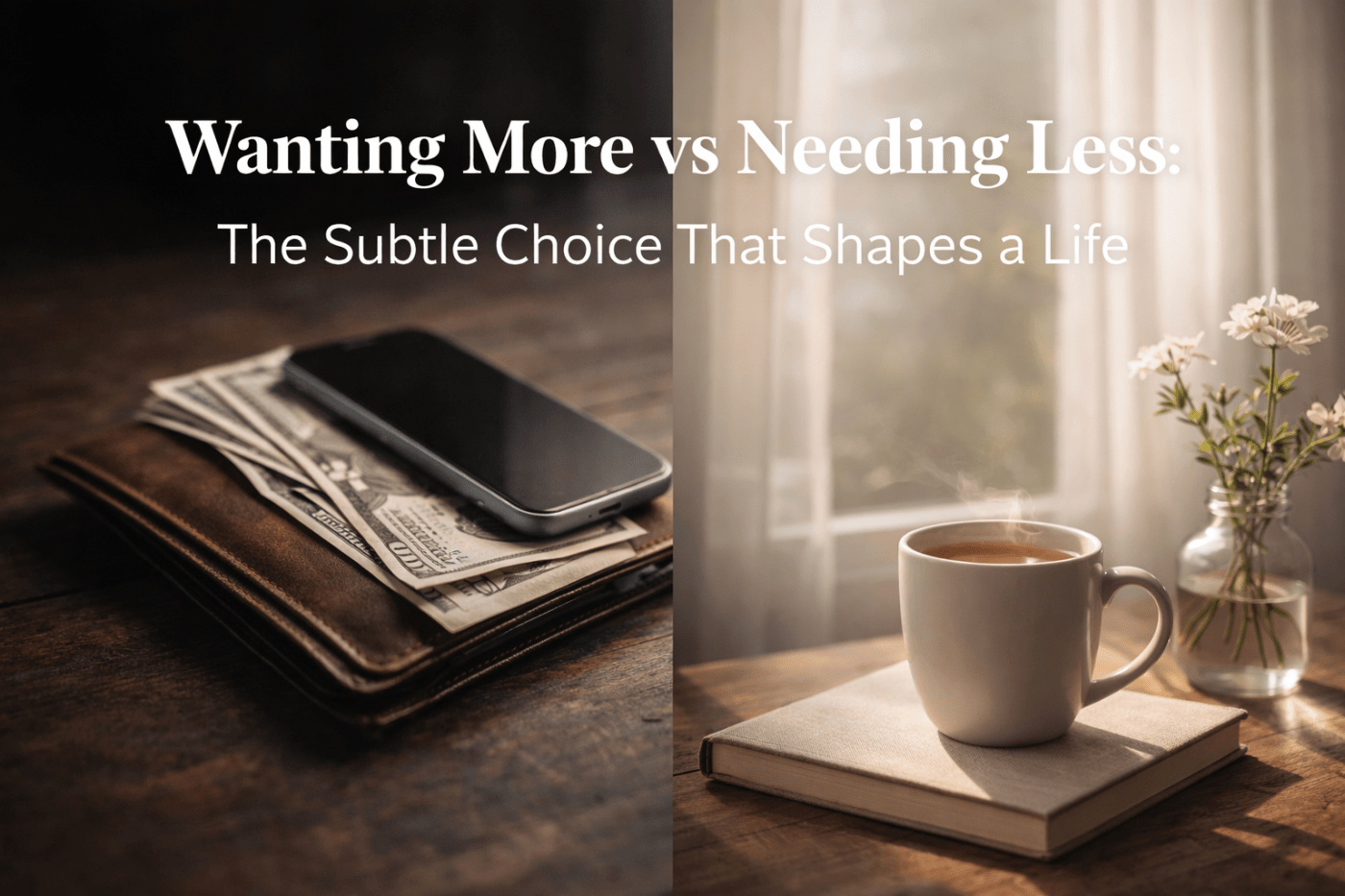
One evening, after a long day, you finally sit down with a cup of tea. The house is quiet. Your phone buzzes. A new phone model. A better salary post from someone you know. A vacation reel from a stranger who seems endlessly happy. Suddenly, the tea tastes less comforting. Nothing changed in the room—but something shifted inside you.
That moment captures the quiet difference between wanting more and needing less.
They may sound similar on the surface, almost interchangeable, but they lead lives in completely opposite directions. One is loud, restless, and always hungry. The other is calm, grounded, and surprisingly powerful.
Let’s talk about that difference—because once you see it, you can’t unsee it.
Wanting More Is a Moving Target
Wanting more feels natural. In fact, we’re taught that it’s healthy. Want more success. Want more money. Want more comfort. Want more recognition. The problem isn’t desire itself—it’s that wanting more rarely knows when to stop.
Think of wanting more like running on a treadmill that slowly increases its speed. At first, it feels manageable. Even exciting. You hit one goal and feel proud—briefly. Then the belt speeds up. The next goal appears. What once felt like abundance now feels like baseline.
A bigger house soon becomes “just the house.” A higher income quietly turns into a new normal with new expenses attached. Even happiness gets postponed to the next milestone.
Wanting more is not wrong. But it is noisy. It keeps asking questions: What’s next? Who’s ahead of me? Why not more? And the louder it gets, the harder it becomes to hear anything else.
Needing Less Is a Subtraction, Not a Sacrifice
Needing less doesn’t announce itself. It doesn’t post updates. It doesn’t demand applause. It simply… settles.
Needing less is not about deprivation. It’s about clarity. It’s the moment you realize that many of the things you chase are solving problems you don’t actually have.
Think of it like cleaning your home after years of accumulation. You don’t feel poorer when you remove clutter—you feel lighter. The room doesn’t shrink. It breathes.
When you need less approval, conversations feel easier.
When you need less validation, decisions feel clearer.
When you need less stuff, life feels more spacious.
Needing less is not about having nothing. It’s about having enough—and knowing it.
The Psychological Gap Most People Miss
Here’s the quiet truth most of us overlook: wanting more is often driven by discomfort, while needing less is driven by self-trust.
Wanting more says, “Something is missing.”
Needing less says, “I am already okay.”
This is why wanting more often feels anxious, even when it’s successful. And why needing less feels calm, even when life isn’t perfect.
A person wanting more may earn twice as much and still feel behind. A person needing less may earn modestly and feel deeply secure. The difference isn’t income. It’s internal pressure.
Modern life trains us to expand endlessly. Needing less is an act of quiet rebellion.
Everyday Life Makes the Difference Obvious
Look at how this plays out in small, ordinary moments.
The person wanting more checks messages compulsively, worried about being overlooked. The person needing less replies when ready.
The person wanting more upgrades constantly, not because the old thing failed—but because it no longer impresses. The person needing less uses something until it genuinely stops serving them.
The person wanting more fills silence with noise. The person needing less is comfortable letting moments be quiet.
Neither lifestyle is advertised as “right.” But only one leads to mental peace.
Why Wanting More Is Loud—and Needing Less Is Powerful?
Wanting more depends on external conditions. Markets, opinions, trends, comparisons. That’s why it feels unstable.
Needing less depends on internal alignment. Values, priorities, self-respect. That’s why it feels steady.
This doesn’t mean you stop growing. It means growth stops being frantic. You still aim higher—but without tying your worth to outcomes. You still improve—but without hating where you are.
Paradoxically, people who need less often achieve more—not because they chase harder, but because they waste less energy proving themselves.
Choosing Less Is Not Giving Up
One of the biggest myths is that needing less means settling. It doesn’t.
It means choosing deliberately. It means saying no to what drains you so you can say yes to what matters. It means realizing that not every opportunity is an obligation.
Needing less is how you reclaim time. Attention. Peace.
And those, it turns out, are the rarest forms of wealth.
The Quiet Question Worth Asking Yourself
So here’s a gentle question—not a judgment, just an invitation:
Are you wanting more because it excites you—or because you’re afraid to stop wanting?
If you paused the chase for a moment, what would still feel essential?
Often, the answer is smaller than we expect. And far more meaningful.
Final Thoughts: Less Noise, More Life
The quiet difference between wanting more and needing less isn’t about ambition versus laziness. It’s about noise versus clarity.
One fills your life with motion.
The other fills it with meaning.
In a world shouting “more, more, more,” choosing less isn’t weakness. It’s wisdom.
And once you experience the calm that comes with needing less, you may realize something surprising: you were never lacking—you were just listening to the wrong voice.
What do you think—where in your life are you wanting more when you might need less? Share your thoughts in the comments, or pass this along to someone who’s been feeling overwhelmed lately.

If you found this article valuable, please don’t forget to Like and Subscribe to my blog for more expert insights and updates.

 THE MIND UPGRADE
Leave a comment