03rd January 2026, Gaurav Kumar Singh
A Familiar Morning That Didn’t Feel Dangerous
You wake up. Before your feet touch the floor, your thumb is already awake. One app turns into another. A message reply leads to a reel. A reel leads to a comment. A comment leads to “just one more scroll.”
You might be surprised to learn that nothing unusual just happened.
This is not a lack of discipline. It’s design.
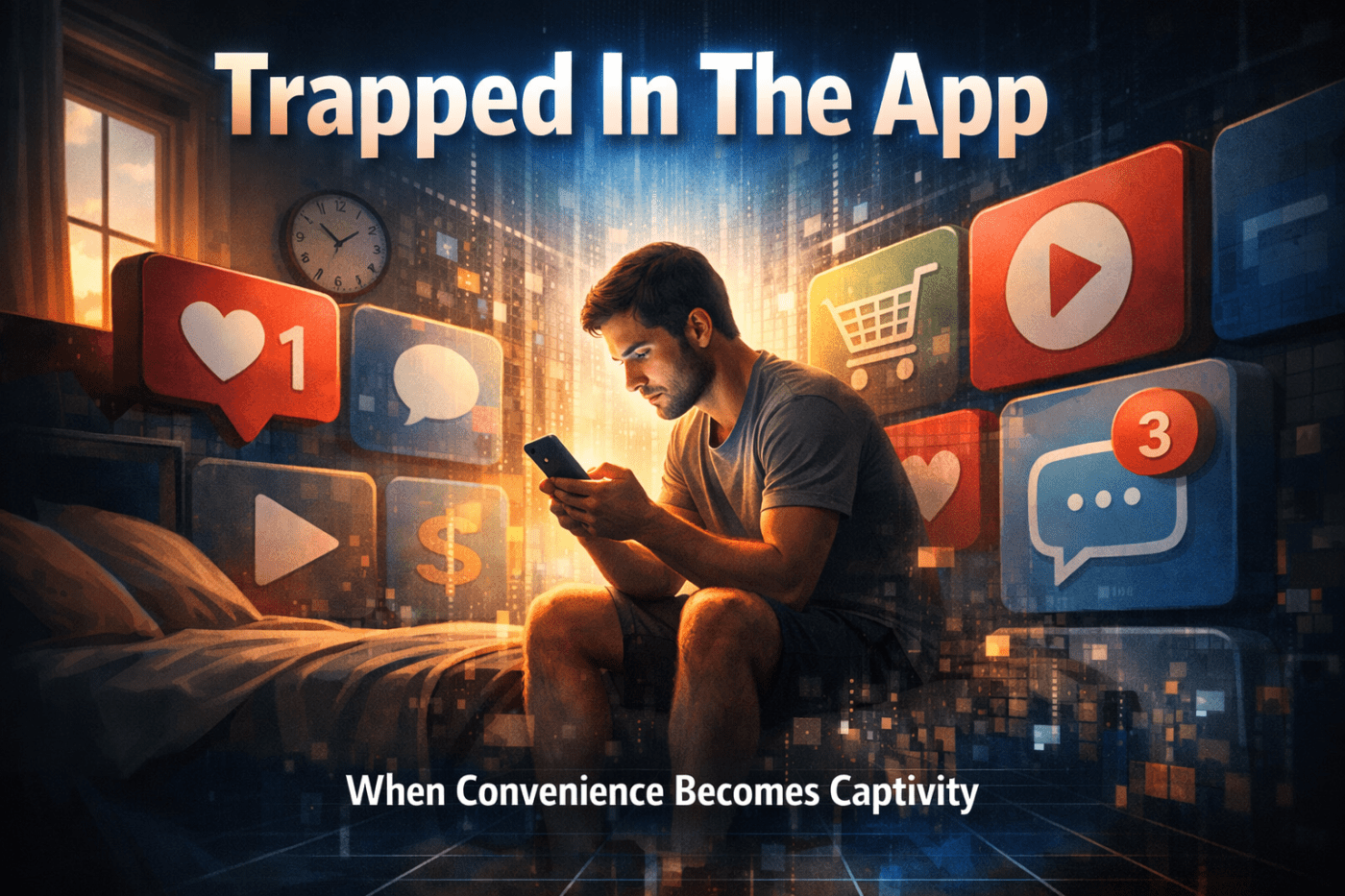
This is what Trapped In The App really means—not locked by force, but held by comfort. Like sitting on a sofa that’s just soft enough to make standing up feel unnecessary.
Think of it like this: the app didn’t kidnap you. It simply made leaving feel inconvenient.
What Does “Trapped In The App” Really Mean?
At its core, Trapped In The App refers to the way digital platforms are built as closed ecosystems. Once you enter, everything you need—or think you need—exists inside. Entertainment, social validation, shopping, learning, news, even loneliness relief.
Imagine walking into a massive shopping mall with no clocks, no windows, and free samples everywhere. You came in to buy socks. Three hours later, you’re holding coffee, listening to music, and wondering where the time went. You’re not lost. You’re contained.
Apps work the same way. They reduce friction inside the app and increase friction outside it. External links load slower. Notifications pull you back in. Content never truly ends. The exit door is technically there, but it’s not inviting.
That’s the trap—not confinement, but convenience.
How Apps Gently Tighten the Net
Let me share a simple story.
A friend once told me he opened a video app to watch a tutorial on fixing a leaky tap. Forty minutes later, the tap was still leaking, but he knew the life story of a street-food vendor in another country.
That wasn’t accidental.
Apps are designed around one powerful idea: attention is the currency. Algorithms observe what makes you pause, smile, react, or rage—and then quietly serve more of it. It’s like a bartender who remembers your favorite drink and refills it before you ask. Eventually, you stop thinking about when to leave.
Autoplay, infinite scroll, personalized feeds, and push notifications are not features; they are behavioral loops. Each loop feels harmless on its own. Together, they form a habit highway with very few exits.
And here’s the clever part: it doesn’t feel manipulative because it feels personal.
Why Being Trapped Feels So Comfortable?
Here’s the paradox of Trapped In The App: most people don’t feel trapped at all.
Apps give us speed, simplicity, and social connection. They help small businesses grow, allow creators to reach audiences, and give ordinary people a voice. That’s the upside—and it’s real.
But there’s a trade-off.
When everything is optimized for engagement, reflection becomes inefficient. Silence feels awkward. Boredom feels illegal. You reach for the app not because you need it, but because your mind has learned that discomfort can be escaped instantly.
Think of it like eating snacks instead of meals. You’re never starving, but you’re never fully nourished either.
Over time, the app becomes the default space where life happens—replacing slower, messier, offline experiences that don’t deliver instant rewards.
Real-Life Consequences We Rarely Talk About
Being Trapped In The App doesn’t just affect screen time. It subtly reshapes how we think, decide, and feel.
Conversations become shorter. Patience becomes thinner. Opinions become sharper and less flexible. When algorithms constantly reinforce what you already like or believe, the world starts to feel smaller, louder, and more polarized.
I once heard someone say, “I don’t read news anymore. I just see what shows up.” That sentence should worry us more than it does.
Because when apps decide what you see, they also influence what you don’t see.
And absence, as we know, is powerful.
The Illusion of Control
“But I can quit anytime,” we tell ourselves.
Of course you can. Just like you can leave the mall whenever you want. Yet somehow, you don’t.
The illusion of control is the strongest part of the trap. We choose the app, customize the feed, mute notifications. It feels empowering. But the system still decides the tempo, the rewards, and the rhythm.
It’s like driving a car where you control the steering wheel, but the road decides where you can go.
That’s not helplessness—but it’s not full freedom either.
Where This Is All Heading?
Looking ahead, the idea of Trapped In The App is only going to intensify.
Apps are becoming super-apps. One login, many services. Messaging, payments, shopping, entertainment, work—all under one roof. The walls get taller, not because they’re enforced, but because leaving means losing convenience.
Artificial intelligence will make these systems even more personalized, more predictive, and more persuasive. The app won’t just respond to you; it will anticipate you.
The question we need to ask is not “Are apps bad?” but “Who is in control of our attention?”
Because attention, once outsourced, is hard to reclaim.
Learning to Step Outside Without Rejecting Technology
This is not a call to delete everything and move to the mountains.
It’s an invitation to notice.
Notice when you open an app without intention. Notice how often silence pushes you toward a screen. Notice how rarely you reach the bottom of anything anymore.
Awareness is the first exit door.
When you name the experience—Trapped In The App—you begin to loosen its grip. You start choosing tools instead of living inside them.
And that shift, small as it seems, changes everything.
Final Thoughts: The App Should Serve You, Not Contain You
Technology is a remarkable servant and a terrible master. Apps can enrich our lives, but only if we remain conscious users instead of passive residents.
So next time you unlock your phone, pause for half a second and ask yourself: Why am I opening this?
That single question might be the most powerful feature you have.
If this resonated with you, share it with someone who’s always “just checking something.” Leave a comment with your thoughts, or explore related topics on digital well-being, attention economy, and mindful technology use. The conversation is just getting started.
If you found this article valuable, please don’t forget to Like and Subscribe to my blog for more expert insights and updates.
 THE MIND UPGRADE
Leave a comment