19th December 2025, Gaurav Kumar Singh
You know that moment in the supermarket when you pause, mid-aisle, holding a neatly packed box that screams “healthy” in calming greens and earthy browns? The label promises goodness, balance, maybe even a better version of you. You drop it into your cart with a small sense of victory. Been there. I have too.
Here’s the uncomfortable truth you might be surprised to learn: inside that healthy label are empty calories—and they’re far more common than we’d like to admit.
Before you feel cheated or defensive, don’t worry. This isn’t about blaming your choices. It’s about understanding how modern food marketing works, why it matters to your body, and how you can gently outsmart the system without turning every grocery trip into a science exam.
Let’s unpack this together, one label at a time.
What Does “Empty Calories” Really Mean?
If calories were currency, empty calories would be counterfeit notes. They look valuable, they take up space, but they don’t buy you anything useful.
Empty calories are foods that provide energy but little to no nutritional value. They’re low in fiber, vitamins, minerals, and protein—the things your body actually needs to function well. Think of it like filling your car with low-quality fuel. The engine runs, sure, but not smoothly, and definitely not for long.
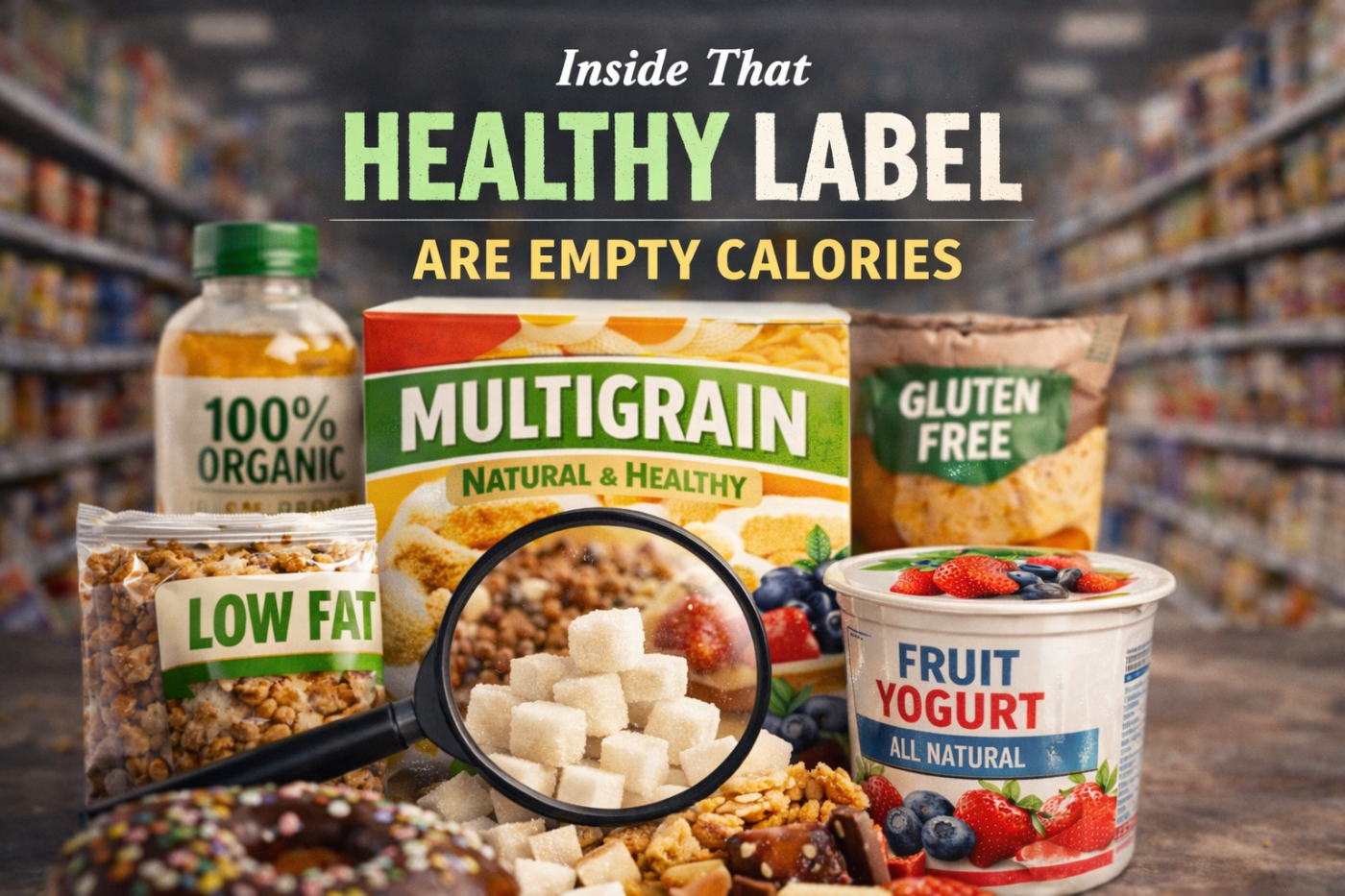
Now here’s where it gets tricky. When we imagine empty calories, we think of soda, candy, or deep-fried snacks. Obvious villains. But today, inside that healthy label are empty calories hiding in plain sight—breakfast cereals, energy bars, flavored yogurts, plant-based snacks, and even so-called “diet” foods.
It’s like attending a motivational seminar that’s all hype and no substance. You feel inspired for ten minutes, then oddly drained.
How “Healthy” Labels Became the Perfect Disguise?
Walk through any grocery store and notice how packaging talks to you. Words like “natural,” “low-fat,” “multigrain,” “no added sugar,” and “plant-based” float off boxes like reassuring whispers. But here’s the catch: many of these words are marketing terms, not nutritional guarantees.
Think of it like a resume with impressive adjectives but no real experience behind them. The design is clean, the fonts feel trustworthy, and the imagery suggests farms, sunshine, and happy families. Meanwhile, the actual food inside is often heavily processed, stripped of fiber, and sweetened just enough to keep you coming back.
I once watched a friend switch from traditional sweets to “healthy” snack bars during a fitness phase. The bars looked virtuous, but a closer look revealed they were essentially compressed sugar with a sprinkle of protein for decoration. He felt hungrier than before and couldn’t understand why. The answer was simple: inside that healthy label are empty calories, dressed up in gym clothes.
Why Empty Calories Matter More Than You Think?
At first glance, calories are calories, right? Not quite.
Your body isn’t just counting energy units like a calculator. It’s asking deeper questions. Where is the fiber? Where are the micronutrients? Where is the signal that says, “You’re full now, relax”?
Empty calories fail that conversation. They spike your blood sugar, give a short burst of energy, and then vanish—leaving hunger, fatigue, and cravings behind. It’s like eating a beautifully iced cake when what you really needed was a proper meal.
Over time, this pattern quietly affects your weight, digestion, focus, and even mood. You eat enough, sometimes too much, yet your body still feels undernourished. That’s one reason people say, “I eat healthy, but I don’t feel healthy.”
The missing link often lies in realizing that inside that healthy label are empty calories quietly sabotaging your efforts.
Real-Life Examples We Rarely Question
Let’s make this practical, because theory doesn’t help much at dinnertime.
Take fruit-flavored yogurt. It sounds wholesome. But many versions contain more sugar than a dessert, with minimal protein and almost no fiber. It’s fruit in name, candy in behavior.
Or consider packaged juices labeled “100% natural.” Without the fruit’s fiber, they act more like liquid sugar than nourishment. Drinking them is closer to sipping soda than eating fruit, even if the bottle shows smiling oranges.
Then there are baked chips, protein cookies, and gluten-free snacks that people assume are automatically healthier. Some are better choices, yes. Many are not. They’re refined carbohydrates wearing a wellness costume.
It’s a bit like choosing a movie based on its poster alone. Sometimes you’re entertained. Other times, you wonder how two hours disappeared with nothing memorable to show for it.
The Psychology Behind Why We Fall for It
Here’s where things get human.
We want to believe we’re making good choices. We’re busy, tired, and juggling responsibilities. If a product promises health, convenience, and taste in one neat package, our brain happily accepts the deal.
There’s also something called the “health halo” effect. Once a food is labeled healthy, we unconsciously give it moral points. We eat more of it. We question it less. We trust it.
I’ve done this myself—grabbing an extra serving because it felt safe. Only later did I realize that inside that healthy label are empty calories adding up quietly, meal after meal.
This isn’t weakness. It’s psychology, expertly exploited.
How to Gently See Through the Illusion?
You don’t need to memorize nutrition science or avoid packaged food forever. The goal isn’t perfection; it’s awareness.
Think of food like a conversation. Whole foods—fruits, vegetables, legumes, nuts, eggs, simple grains—speak clearly. They fill you up, digest slowly, and leave you satisfied. Ultra-processed “health” foods talk fast, promise big, and disappear quickly.
A simple mindset shift helps: ask whether the food will still make sense without the label. If the packaging vanished, would it still look like food your grandmother would recognize?
When you start thinking this way, the fog lifts. You begin to notice patterns. And suddenly, spotting empty calories becomes less about rules and more about intuition.
Looking Ahead: A Smarter Relationship with Food Labels
The future of healthy eating isn’t about demonizing brands or obsessing over every ingredient. It’s about informed choices and honest conversations.
As consumers become more aware, companies will be forced to improve transparency. Some already are. Until then, your greatest advantage is curiosity.
Next time you pick up something labeled “healthy,” pause for a second. Not in fear, but in curiosity. Remember that inside that healthy label are empty calories more often than we’re told—and knowing that gives you power.
Final Thoughts: Read Beyond the Promise
Healthy eating doesn’t start with labels. It starts with understanding how food makes you feel over time, not just in the moment.
If this article made you rethink even one product in your kitchen, it’s done its job. Share it with someone who loves “healthy snacks,” leave a comment with your own label-discovery story, or explore related topics on food myths and modern nutrition.
Because the more we talk about what’s really inside our food, the harder it becomes for empty calories to hide behind healthy words.

If you found this article valuable, please don’t forget to Like and Subscribe to my blog for more expert insights and updates.

 THE MIND UPGRADE
Leave a comment