01st December 2025, Gaurav Kumar Singh
Introduction: The 30-Second Spiral
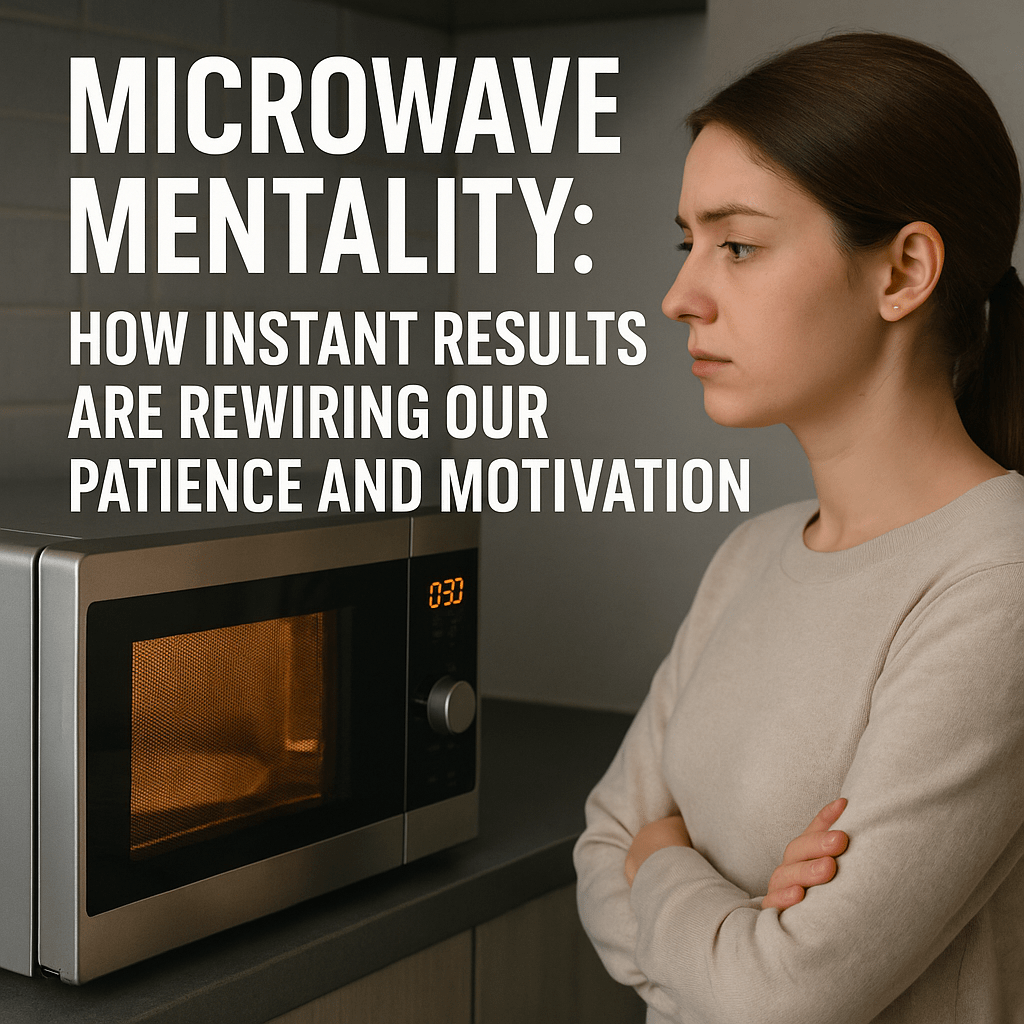
Picture this. You’re standing in front of the microwave, watching your food rotate like it’s auditioning for a reality show. The timer says 30 seconds, which is nothing—literally half a minute. But somehow, your brain whispers, “Why is this taking so long?”
You tap the counter. You check your phone. You sigh dramatically as if the universe has betrayed you.
If you’ve ever felt this, congratulations—you’ve met microwave mentality, the invisible shift in our minds caused by a world that delivers everything instantly.
Before we dive deeper, here’s the short, featured-snippet style answer you might be looking for:
Microwave mentality refers to the modern expectation for instant results—shaped by technology, fast conveniences, and on-demand everything—which gradually reduces our patience, raises our expectations, and diminishes long-term motivation.
Now, let’s unpack the story behind this mental rewiring, one relatable moment at a time.
What Exactly Is “Microwave Mentality”?
Think of microwave mentality like a mental muscle that has been trained to expect the world to move at the pace of your Wi-Fi. It didn’t happen overnight. It happened one food delivery, one instant message, and one lightning-fast Google search at a time.
You might be surprised to learn that psychological studies actually show that when rewards become immediate, our brains slowly lose the ability to wait, work, or tolerate discomfort. It’s like going to the gym but only lifting featherweights—you lose strength without even realizing it.
I once met a teenager who said, “If a video takes more than three seconds to load, I just skip it.” I laughed… then remembered I do the same thing. It’s not their generation—it’s all of us. We’ve been conditioned.
How Instant Gratification Rewires Patience?
Imagine pre-Internet days when sending a letter meant waiting a week for a reply. Today, if someone takes more than 5 minutes to respond on WhatsApp, we start mentally drafting conspiracy theories.
Here’s a real-life analogy:
Patience is like a rubber band. Stretch it slowly and it expands. Yank it quickly and it snaps. Modern life constantly yanks.
Streaming services autoplay the next episode. Online shopping tells you the exact location of your package (and still leaves you annoyed if it arrives “late” in 24 hours). Even meditation apps now have “quick 1-minute calm sessions” because… yes, we need shortcuts to even relax.
Our environment has changed faster than our brains have evolved, so patience becomes the casualty.
Expectation Inflation – When ‘Fast’ Becomes ‘Not Fast Enough’
There’s a funny story I often tell. A friend once complained that his food delivery app took “forever.” How long, I asked?
He stared at me and said, “Twenty minutes.”
Twenty. Minutes.
That’s the time it takes to chop one onion.
But this isn’t a one-off incident—this is expectation inflation. Once we experience speed, anything slower begins to feel unreasonable. And the worst part? We rarely notice the shift.
Think of it like upgrading your phone. The day you get it, it feels blazing fast. A year later, the same phone makes you roll your eyes. Nothing changed—except your expectations.
This inflation affects everything: career progress, personal growth, relationships. We expect instant success, instant transformation, instant clarity. When life moves at its natural pace, it feels like lag.
Motivation in the Age of Instant Everything
Here’s the tricky part: motivation behaves like a long-distance runner. It thrives on slow progress, effort, and delayed gratification. But our brains, increasingly shaped by microwave mentality, crave quick wins.
Think of starting a fitness journey. Day 1, you feel inspired. Day 3, you look in the mirror… nothing changed. Your brain, accustomed to instant updates and immediate feedback, says, “This isn’t working.”
Or consider learning a new skill. Earlier, we accepted that mastery takes years. Today, after two YouTube tutorials, we wonder why we aren’t experts yet.
This mismatch—between long-term goals and instant-result expectations—is where motivation collapses.
A friend once told me, “I stopped learning guitar because I didn’t improve quickly.” I said, “How long did you try?”
He replied, “Like, three days.”
Classic microwave mindset.
Why Microwave Mentality Matters More Than We Think?
Microwave mentality seems harmless. After all, what’s wrong with wanting things faster? But beneath the surface, it chips away at deeper qualities—patience, discipline, resilience, emotional endurance.
These are the qualities that build careers, relationships, health, and long-term happiness.
When everything in life feels “too slow,” we become restless. When progress doesn’t happen instantly, we give up. When discomfort appears, we run.
It’s not just about technology. It’s about how we train our minds to respond to life.
Imagine planting a seed and expecting it to sprout in an hour. Sounds absurd, right?
Yet emotionally, that’s what microwave mentality makes us do.
A Forward-Looking Perspective – Reclaiming the Slow Lane
The good news? Our minds are flexible. We can re-train them. It doesn’t require renouncing technology or moving to a forest (unless you want to, in which case send me photos).
All it needs is tiny intentional shifts—waiting a little longer, embracing boredom occasionally, doing things without shortcuts.
Next time you heat something in the microwave, try this:
Instead of watching the seconds tick down impatiently, take a breath. Notice the silence. Let those 30 seconds be slow.
Because life doesn’t need to run at 5G speed to be meaningful. Sometimes, slowing down is how we start living again.
Conclusion: The Reminder We Didn’t Know We Needed
Microwave mentality isn’t a flaw—it’s a consequence of the world we live in. But awareness gives us power. When we understand how instant results shape our minds, we can consciously choose patience, persistence, and presence.
So the next time something takes a little longer, ask yourself—
Is the world slow?
Or am I just used to fast?
If this article made you pause or reflect, I’d love to hear your thoughts. Share your experiences, drop a comment, or explore more stories on modern living and mindset. Let’s reclaim the joy of waiting—one slow moment at a time.

If you found this article valuable, please don’t forget to Like and Subscribe to my blog for more expert insights and updates.

 THE MIND UPGRADE
Leave a comment