08th October 2025, Gaurav Kumar Singh
Introduction: A Morning That Feels Like Magic (and Maybe a Little Creepy)
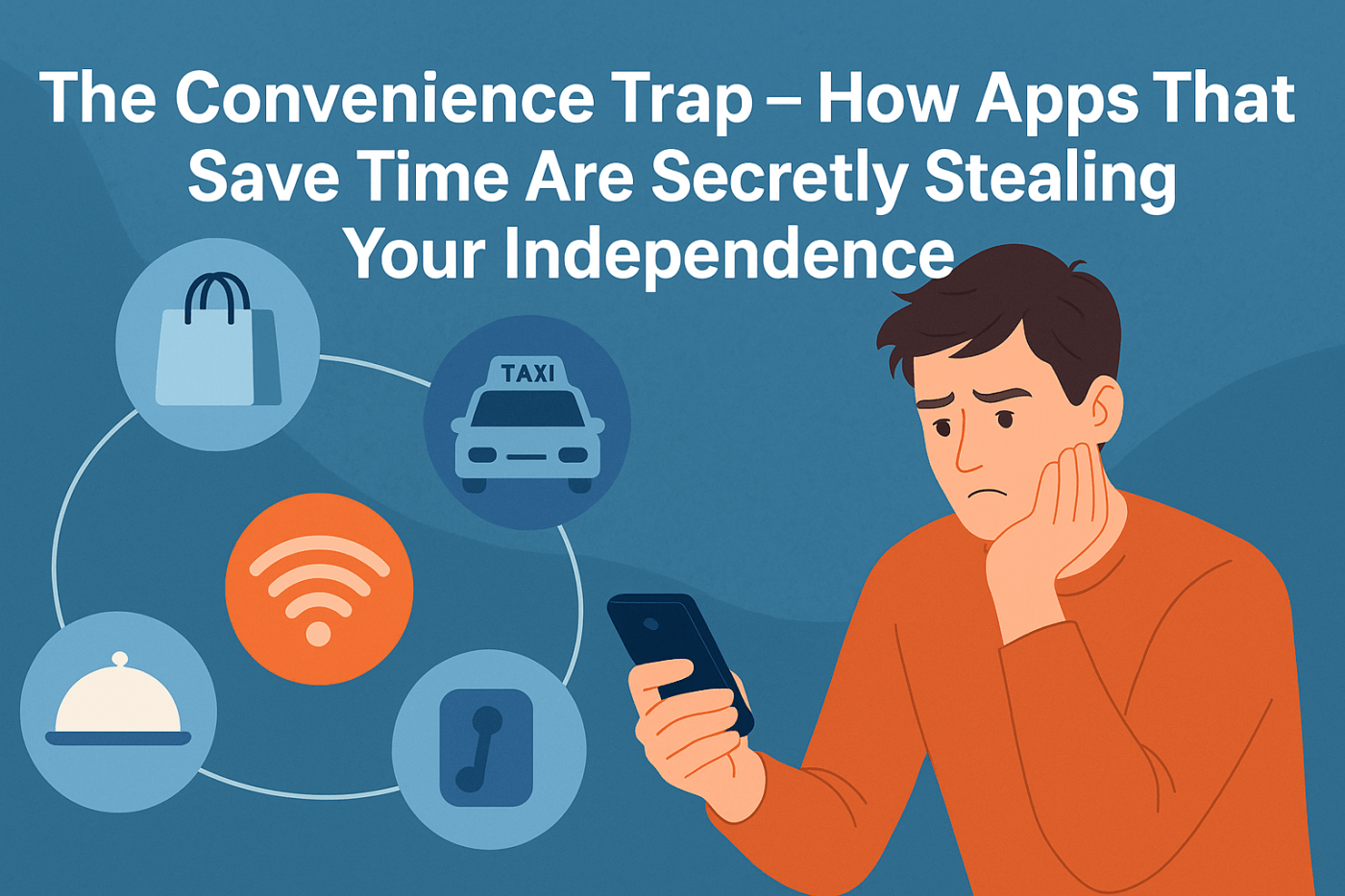
It’s 7:15 a.m. You blink, reach for your phone, and—in the space of a few taps—you’ve got your coffee delivered, your groceries scheduled, your weather report, the fastest traffic-free route to work, and even a daily podcast queued up. Efficiency level: superhero.
But then pause for a moment. Think of it like this: you’ve just delegated nearly your entire morning routine to algorithms. You didn’t choose most of those services consciously—they popped in because they promised ease. You might be surprised to learn how that ease, over time, can quietly hollow out your self-reliance. Welcome to the world of the convenience trap.
In one sentence: the convenience trap is the subtle process by which time-saving apps and services shift small, everyday decisions and actions out of your hands—gradually weakening your independence. The rest of this post traces how that happens, why it matters, and what you can do to resist it.
What Is the “Convenience Trap,” Really?
From Helper Tools to Reliance Mechanisms
At first, apps are just tools—like a hammer or a map. You use them to make life easier. But over time, when you stop practicing the underlying skill (like navigating, cooking, choosing, budgeting), you lose touch with it. And at that point, the app stops being a tool and becomes a crutch.
Imagine if you always used a GPS—even for places you’ve visited dozens of times. Over time, your sense of direction starts to atrophy. You stop remembering landmarks; you no longer notice a street sign or a shortcut. That’s a benign example of what convenience apps can do to more cognitively demanding tasks (like decision-making, planning, or even social skills).
The Slippery Slope: Convenience → Habit → Dependence
Habit is the bridge. The first time you let an app pick your lunch delivery, it feels like a treat. Next time, you do it without thinking. Then it becomes your default choice. Before you know it, you can’t remember when you last actually walked into a restaurant and ordered in person.
That shift—from optional convenience to default mode—is the signature of the convenience trap. Your independence doesn’t vanish in a day; it gets chipped away, decision by decision, app by app.
Why It Matters: The Hidden Costs of Convenience
Erosion of Decision-Making Muscle
When every decision—big or small—is outsourced to an algorithm or app, your brain gets less exercise. You stop weighing pros and cons, comparing options, making tradeoffs. In effect, your decision-making muscle weakens, and you become more passive.
It’s like if you never lifted weights because a machine did it for you. Your muscles atrophy. In the digital realm, your cognitive muscles weaken if they’re never used.
Diminished Agency & Overshadowed Identity
We tend to think of identity in big terms: your job, your beliefs, your goals. But identity also lives in small acts—what you choose to wear, read, cook, explore. If apps gradually direct those choices, your life starts to feel filtered through someone else’s preferences (or an algorithm’s). You lose agency over your daily life.
Vulnerability to Systemic Control
Here’s a bigger, scarier layer: when you become dependent on services, you’re one outage, one app policy change, one blackout, or one algorithm tweak away from disruption. If your food delivery app changes its pricing or your transportation app limits access, you are forced to adapt—often helplessly.
In the same way people once depended on a single utility provider for water or electricity, now many depend on a handful of digital services for mobility, food, logistics. That concentration of control carries risk.
The Subtle Value of Friction
We often think friction (delays, effort) is bad. But friction has value: it forces deliberation, checks rash impulses, gives space to reflect. Without friction, you act on autopilot. Convenience erases friction—and with it, a chance to pause, choose, learn.
Real-Life Examples: When Convenience Becomes Captivity
Story: The Ride-Hailing Spiral
Meet Riya. When she moved to a big city, she started using ride-hailing apps to save time. Initially, it was a blessing: no more waiting at bus stops, no more walking under the hot sun. But after a few months, she realized she no longer knew the bus routes, how to read metro maps, or how to time a walk to the train station.
One evening, the ride app glitched. Prices skyrocketed. No cabs in the vicinity. Riya, lost, had to walk through unfamiliar streets to find a bus station she barely remembered, flag down a shady local vehicle, deal with haggling and delays. It felt like she’d forgotten how to manage her own mobility—her independence—once convenience was removed.
Story: The Meal Plan That Takes Over
Meet Arun: He loves good food—but also hates cooking. He uses multiple food delivery apps. Over the years, he stopped planning meals, shopping for ingredients, and even scanning local markets. Now, even for simple breakfasts, he scrolls apps. He’s lost the spontaneity—or capacity—to “just make something with what’s in the fridge.” The day the app’s servers were down, he stared at his pantry for 20 minutes, confused.
Story: Smart Home, Dumb Owner?
Consider the smart-home lover who programs everything—temperature, lighting, reminders. Sounds great, until one day the system fails, and they don’t remember how to fish out a light switch fuse, adjust the AC manually, or even work a physical thermostat. All those little survival skills fade.
The Upside: Why We’re Seduced (Yes, There Is a Good Side)
Let’s not pretend these apps are evil. They bring real efficiencies. They help busy parents, people with mobility constraints, those juggling multiple responsibilities. They let us focus on what matters: work, relationships, creativity.
The trick is balance. Convenience itself isn’t bad—it becomes risky when it becomes our only mode of operation.
How to Break Free (or Resist Falling In)
Cultivate Intentional Friction
Deliberately introduce some friction into areas where it matters: turn off “auto-order” features, limit default settings, unsubscribe from “one-tap” conveniences. For instance, schedule times when you cook even if it’s less efficient. You might rediscover joy and resourcefulness.
Practice the Skills You’re Losing
Once a week, map your route manually, shop at a local market, choose a meal instead of ordering it. Use a paper map, ask locals for directions. You don’t need to do it all the time—just enough so your muscles stay active.
Use Apps as Tools, Not Masters
Keep control. Before downloading a new time-saving app, ask: What skill am I outsourcing? What will I lose if this breaks? What can I still do myself? Maintain backups (like offline maps, physical cash, manual planning).
Periodic Digital Fasts
Set “no-app” hours—say Sunday mornings or a few hours in the evening—where you live analog. Walk without checking navigation every 100 meters. Make decisions without consulting a recommendation engine. Let yourself feel the friction.
Build “Plan B” Systems
Even for conveniences, keep alternatives. For delivery, find local shops you can walk to. Learn basic cooking or repair. Keep a paper or offline reference for essential tasks. That way when an app fails, you aren’t stranded.
Looking Forward: The Future of Convenience and Autonomy
As AI, automation, and predictive services get more powerful, the convenience trap only deepens. Soon your environment might anticipate your needs before you even ask. But that’s precisely why we need to stay vigilant.
Societies will need to think about digital resilience—teaching citizens not only to consume services but to retain core competencies. Schools, libraries, community centers could teach analog skills that apps are making obsolete—navigation without GPS, budgeting without fintech, memory without assistants.
Technology companies may respond with tools that help you wean yourself from dependency—“autonomy modes,” “skill maintenance features,” “convenience limits.” I hope so.
Your task—one at a time—is to decide where you’ll draw your personal line. The trap isn’t doomed inevitability; awareness is the first step to escape.
Conclusion & Call to Action
So, what’s the bottom line? The convenience trap isn’t a villain with horns—it’s the slow erosion of independence through everyday outsourcing. Apps that save minutes may, in the long run, cost us skills, agency, and resilience.
You don’t have to go full Luddite. You just need to stay conscious. Introduce friction, practice lost skills, keep backups, and set boundaries with convenience.
I’d love to hear from you:
Which convenience app do you depend on most? When was the last time it failed you? What’s one analog skill you’d like to bring back into your life?
Leave a comment, share this post with someone who’s feeling a bit “sluggish in autonomy,” and if you like, I can write follow-ups: “How to audit your digital dependence,” “Practical friction hacks,” or “Rebuilding lost skills in modern life.”
Stay thoughtful, stay human.

If you found this article valuable, please don’t forget to Like and Subscribe to my blog for more expert insights and updates.
 THE MIND UPGRADE
Leave a comment