5th October 2025, Gaurav Kumar Singh
Introduction: A Moment of Surprise
Imagine this: It’s mid-November, you’re cleaning out your email clutter, and you spot a charge from a service you barely remember signing up for. It’s only ₹199 per month — “no big deal,” you think — and you mumble, “Oh, that’s nothing.” You delete the email. Then a few weeks later, another small charge appears. And yet another. By the end of the year, these “little” costs have quietly cost you several thousand rupees.
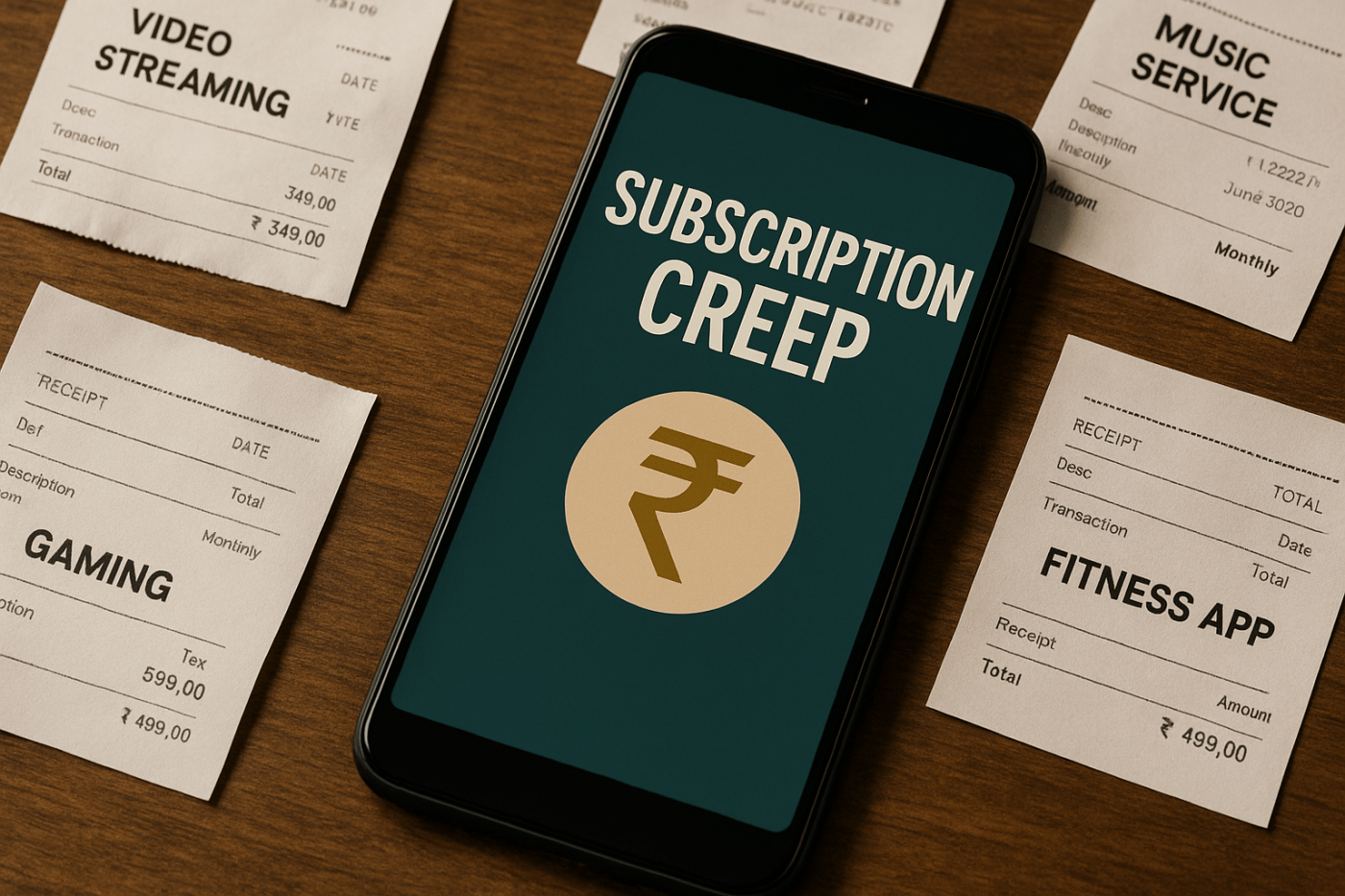
That, my friend, is subscription creep in action: those small, recurring charges you forget about — until they accumulate and hit you in the wallet. In this post, I’ll walk you through what subscription creep is, why it matters, how it happens, and (most importantly) how to stop it.
What Is Subscription Creep?
Subscription creep refers to the phenomenon where multiple small, recurring charges — often ones you barely notice — accumulate over time and start to bleed your finances without your awareness. These charges are typically monthly (sometimes annual) fees for digital services, apps, or membership platforms that quietly renew themselves.
Why “creep”? Because this process is stealthy: you don’t feel the impact at first. A few rupees here, a few there — each by itself seems harmless. But over the months (or years), they add up to something significant.
Why It Matters (Spoiler: It Adds Up!)
You might be skeptical: “Can a few rupee subscriptions really matter?” The simple answer: yes — especially in aggregate.
Picture subscription creep as a slow drip from a tiny leak in your roof. One drip seems harmless; a dozen drips over a rainy night floods your room. Those unnoticed subscriptions are like that drip. Individually they’re tiny, but altogether they cost you in a way you’ll notice — eventually.
In financial planning, even small amounts matter: ₹200/month is ₹2,400/year; ₹500 across three services is ₹18,000/year — and remember, you might have dozens of such services.
How Subscription Creep Works — The Mechanism
Here’s how the creep usually unfolds:
Free trial trap: You sign up for a free trial of something (an app, streaming, a service) and you enter your card. You plan to cancel before the trial ends — but life happens, you forget. The subscription auto-renews, and now you’re paying.
Out-of-mind renewals: A subscription renews annually or monthly and you don’t get a reminder (or overlook it). Because the charge is small, you shrug it off.
Price creep / hidden upsells: Services often hike prices or add add-ons. You were paying ₹149/month; next year it becomes ₹179 + tax + “premium features.” If you’re not paying close attention, that extra 20-50 rupees a month slides in unnoticed.
Compounding pile: A few services — cloud storage, a design app, a music streaming service, a backup tool, a niche productivity app — all quietly renewing. You don’t feel each one, but together they form a bundle you didn’t intentionally budget.
Subscription inertia & forgetfulness: Because they’re automated, you never revisit them. Maybe you think “I’ll check later” and never do. Soon your bank statement becomes a museum of forgotten subscriptions.
Real-Life Examples You Can Relate To
Let’s walk through a few relatable scenarios:
Example 1: The Writer’s Toolkit
You’re a blogger. You have Grammarly Premium, a cloud backup (say, 1 TB), a premium font library, a productivity app, a photo editing suite, premium WordPress plugins. Each by itself is just ₹149, ₹199, ₹299, etc. But together, they might cost ₹1,000–₹1,500 per month. If you rarely use some of them, that’s money leaking out.
Example 2: The Streaming Buffet
Think of your entertainment apps. One month you add a new regional streaming service just to watch a few shows. You forget to cancel. So now you have Netflix, Amazon Prime, Jio Hotstar, a local streaming service, and maybe a music service. Even if each is ₹199–₹499, the total is burdensome.
Example 3: The “Convenience” Subscriptions
These are ones you never see daily — backup services, domain hosting renewals, email tools, a VPN package, or even a subscription box for snacks or grooming. They renew silently.
In each of these, the user often says: “I didn’t realize I was still paying for that.”
Benefits & Impacts — Why You Should Care?
Impacts on Your Budget & Saving Goals
Subscription creep chips away at your disposable income. You may find yourself short when trying to save, invest, or simply trying to reduce expenses. That ₹1,500+/month you could redirect into your emergency fund or invest in something meaningful.
Psychological & Emotional Toll
There’s also a mental cost. That vague feeling of “why is my bank balance shrinking?” is stressful. When small charges haunt your statements, you lose trust in your own budgeting.
Opportunity Cost
Every rupee spent on forgotten subscriptions is a rupee you cannot use elsewhere — like learning something, going on a short trip, gifting something, or even reinvesting in your business. Think: what would ₹15,000/year do for you if it weren’t wasted?
How to Fight Subscription Creep — A Roadmap
You might be asking: “Okay, but how do I stop this quietly creeping leakage?” Here’s a hands-on plan.
Step 1 — Inventory Everything
Start by making a full list of all your subscriptions — monthly, annual, semiannual. Go through:
Credit card statements Bank statements Emails (search “renewal,” “subscription,” “payment receipt”) App subscriptions (Google Play, Apple, web apps) Forgotten services (hosting, domains, backup tools)
Write each one down with how much, when it renews, and whether you use it.
Think of it like doing a spring cleaning in your finances.
Step 2 — Ask the Honest Questions
For each service, ask:
“Do I still use this?” “Is it providing value?” “Could I get the same with something I already have?” “Is there a cheaper plan or alternative?”
If the answer is “no,” cancel it.
Step 3 — Automate Alerts & Use Tools
You can’t rely on memory forever. Use reminders in your calendar before renewal dates. Use financial apps or subscription-tracking tools (many exist) that flag upcoming charges. This is your guard against invisibility.
Step 4 — Negotiate or Downgrade
Many services will reduce your rate if you ask (especially around renewal time) or if you’re willing to commit to a longer plan. Also consider downgrading to a cheaper tier if you don’t use premium features.
Step 5 — Periodic Reviews (Quarterly or Semiannual)
Every three to six months, revisit your subscription list. New ones might have crept in. Some you thought valuable might have lost value. Make canceling unused ones a habit.
Step 6 — Bundle & Consolidate
If possible, consolidate multiple services under one umbrella (for instance, one general cloud storage instead of several small ones). Use bundles if they truly lower cost. Just ensure the bundle doesn’t become another hidden creep.
Looking Ahead: The Future of Subscription Creep & Your Financial Freedom
Subscription models are becoming more common across domains — from cars (paying to unlock features) to smart devices (paying for each “feature”). The risk of creep is only rising.
But here’s the bright side: as consumers become more aware, tools and features to manage subscriptions will improve. We’ll see more dashboards, alerts, transparent renewals, and regulation on “auto-renewal traps.”
For your part, becoming subscription-aware is becoming a modern life skill. Recognizing the pattern, staying vigilant, and taking control is how you protect your money in the long run.
Conclusion & Call to Action
Subscription creep is subtle, sneaky, and surprisingly impactful. Yet it’s also conquerable. With a little time, honesty, and vigilance, you can reclaim hundreds or thousands each year.
Start with inventorying your subscriptions today. Block time in your calendar for a review. Use alerts. And the next time you see a “free trial” or tempting small-price offer, pause — ask whether you’ll truly use it or if it’s just another drip leak.
If you found this article helpful, please share it with friends or family who might be losing money unknowingly. And I’d love to hear from you — what’s the most surprising subscription you discovered paying for? Drop a comment below, and let’s help each other plug those leaks.

If you found this article valuable, please don’t forget to Like and Subscribe to my blog for more expert insights and updates.

 THE MIND UPGRADE
Leave a comment