21st September 2025, Gaurav Kumar Singh
A Story That Changed the World
On a spring day in 1796, an English doctor named Edward Jenner scratched a little cowpox material into the arm of an eight-year-old boy, James Phipps. Neither of them could have known it then, but this small act would ignite a revolution in human health. That experiment became the world’s first vaccination, and it eventually paved the way to eradicating smallpox—a disease that once killed millions every year.
Fast forward to today, and vaccines are quietly saving lives every single day. You may not notice it when you go about your routine—dropping kids at school, riding the bus, or heading to work—but behind the scenes, your body’s immune system may already be trained by vaccines to protect you from invisible threats.
So, how do vaccines actually save lives? Let’s break it down in a way that feels less like a biology lecture and more like a story of your body’s personal superhero training program.
What Exactly Are Vaccines?
Think of your immune system as a security team. White blood cells are the guards, constantly patrolling and ready to take down intruders (germs). But here’s the catch: they work best when they know what the enemy looks like.
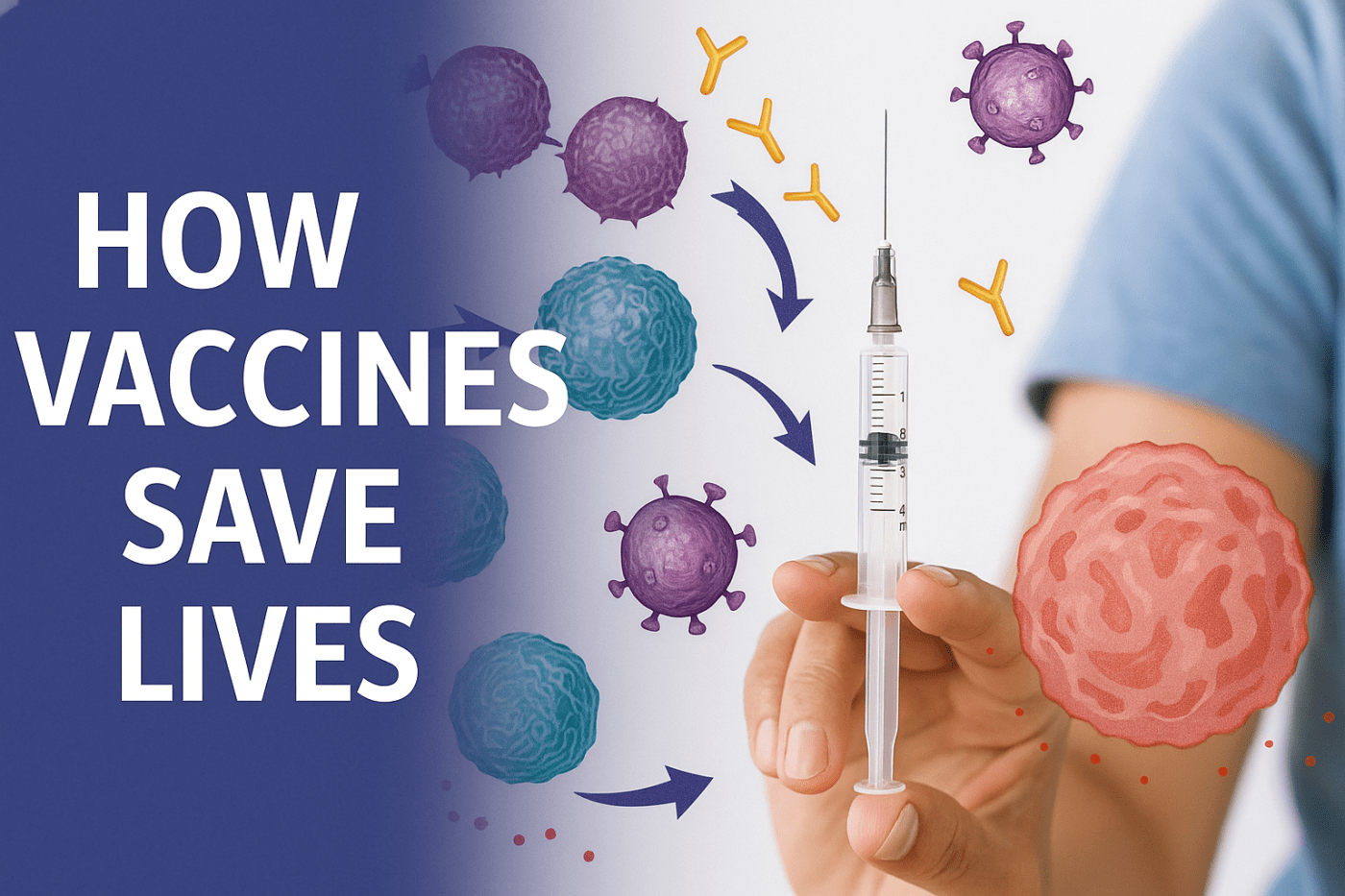
That’s where vaccines come in. Instead of waiting for a real attack by a dangerous germ, a vaccine introduces a harmless version of it—maybe a weakened or dead germ, or even just a piece of it. This is like giving your body a “Most Wanted” poster in advance. Your immune system studies it, trains, and remembers. So, if the real threat ever shows up, your guards don’t panic—they’re ready for battle.
How Vaccines Train Your Body’s Army?
The process is surprisingly elegant. At first encounter, certain immune cells (called lymphocytes) inspect the antigens from the vaccine. It may take about a week for your immune system to find the right defenders and train them, which is why sometimes you feel a bit achy after a shot—it’s your army gearing up.
Some of these cells turn into memory cells, which are like battle-hardened veterans. They stick around in your blood for years, sometimes even for life. When the same germ tries to invade later, the response is lightning-fast. Instead of days or weeks, it only takes hours for your immune system to launch a counterattack.
In simple terms: vaccines help your body skip the “figuring it out” phase and jump straight to the “defeat the enemy” phase.
Real-Life Impact: From Smallpox to Measles
You might be surprised to learn that smallpox once killed five million people every year. Thanks to vaccines, it was completely eradicated by 1980—the first and only human disease we’ve ever wiped out.
Diphtheria, measles, whooping cough, and neonatal tetanus used to devastate families worldwide. Today, these diseases are shadows of their former selves, with vaccines preventing millions of deaths each year. In fact, measles vaccination alone saves over two million children annually.
Imagine a world without vaccines. Outbreaks would be common, hospitals would overflow, and everyday activities like sending kids to school could become risky. Vaccines have quietly made modern life possible.
Are Vaccines Dangerous?
Here’s a question that floats around often: are vaccines risky? The short answer—no. Vaccines are among the most tested and monitored medical tools we have. Side effects, if any, are usually mild and short-lived, like a sore arm or slight fever.
Think of it like going to the gym. Sure, you might feel sore after your first workout, but that’s just your muscles preparing for strength. Similarly, that temporary discomfort from a vaccine is a sign your immune system is getting stronger.
Without vaccines, an estimated 2.5 million more children would die every single year. So, when weighed against the risks, the benefits aren’t just bigger—they’re life-saving.
The Future: Next-Gen Vaccines
The story doesn’t end here. Science is pushing vaccines into a new frontier. Researchers are working on genetic mapping to design vaccines tailored to fight even trickier diseases. Imagine a world where your body’s immune system can be “taught” to outsmart rapidly mutating viruses like the flu—or even target diseases like cancer.
Flu viruses, for example, are like crafty burglars who change their disguises every year. That’s why we need updated flu shots annually. But with next-gen vaccines, we may soon have smarter ways to keep ahead.
Why Vaccines Matter for Everyone?
Here’s the part that often gets overlooked—vaccines don’t just protect you. They protect your community. When most people are vaccinated, germs struggle to spread. This “herd immunity” shields those who can’t get vaccinated, like newborn babies or people with weakened immune systems.
So, when you roll up your sleeve for a shot, you’re not just protecting yourself—you’re protecting your family, your neighbors, and even strangers on the bus.
Wrapping It Up
From a little boy in 1796 to billions of lives saved today, vaccines have reshaped human history. They’re not just medical tools; they’re one of the greatest success stories of science. They train our bodies, protect our communities, and hold the key to fighting future diseases.
Next time you or your child gets a vaccination, think of it as passing another milestone in humanity’s ongoing battle against invisible enemies. It’s not just a shot—it’s a shield.
What about you? Have vaccines changed the way you think about health and safety? Share your thoughts below—I’d love to hear your perspective. And if you found this useful, spread the word. After all, knowledge, like vaccines, saves lives.

If you found this article valuable, please don’t forget to Like and Subscribe to my blog for more expert insights and updates.

 THE MIND UPGRADE
Leave a comment