9th June 2025, Gaurav Kumar Singh
Introduction: A Dream Turning into a Trap
In Indian households, education has always been seen as a sacred path to success. From lower-middle-class families in Bihar to urban households in Bangalore, the narrative is the same: “Get educated, and your future is secure.”
But in the last two decades, this dream has started showing cracks. Students today:
Graduate with outdated degrees.
Lack marketable skills.
Struggle with mental health.
Remain jobless or underpaid.
End up with educational debt and no financial freedom.
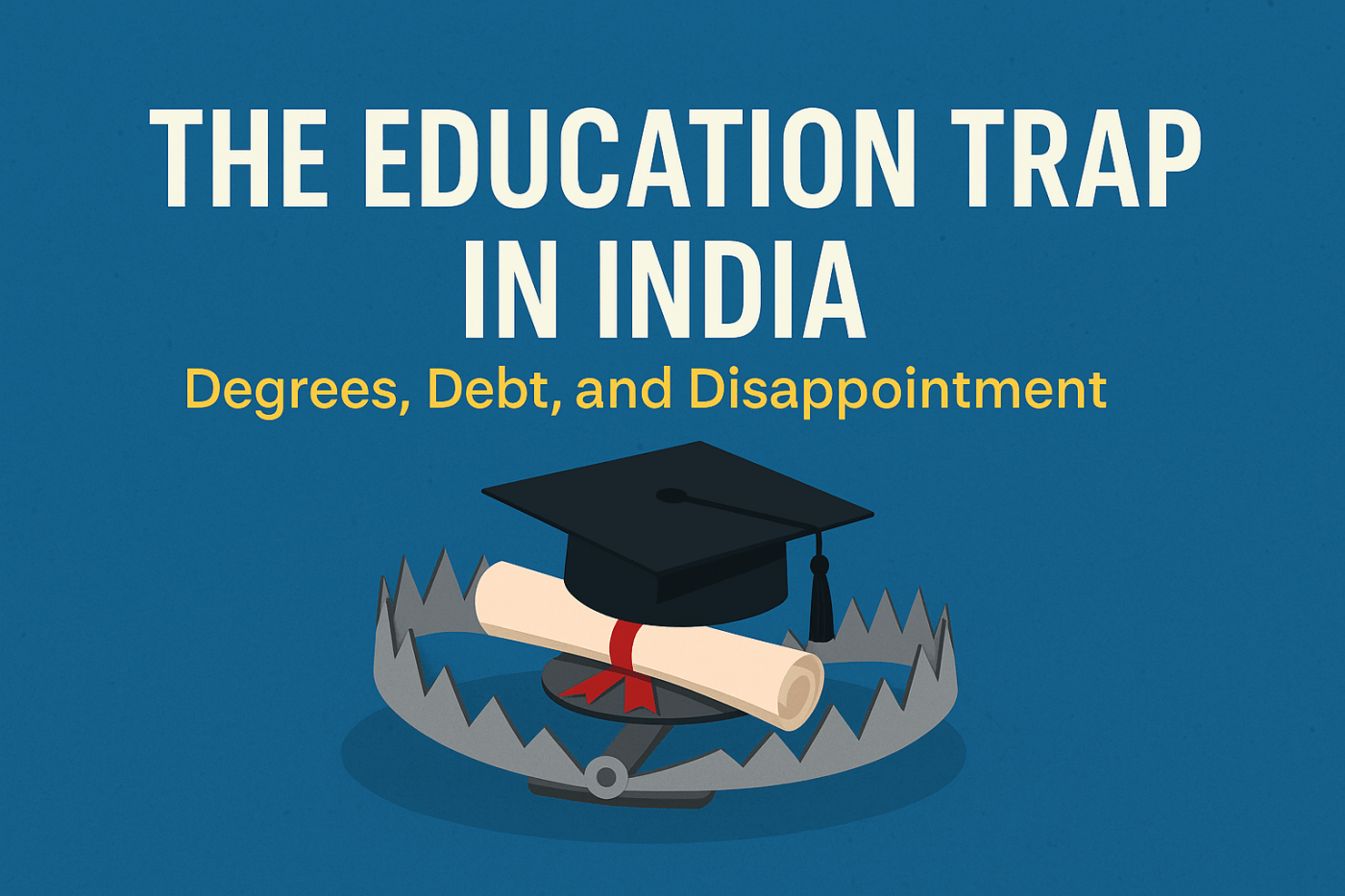
This is the Education Trap in India—a crisis that is growing silently but rapidly, affecting millions every year.
The Alarming Numbers Behind the Trap
Let’s start by looking at some hard-hitting data:
India produces over 3.4 crore graduates every year, but only 45% of them are considered employable by industry standards.
(Source: India Skills Report 2024, Wheebox & CII)
80% of engineering graduates are unemployable, with little exposure to modern technologies like AI, Data Science, or Cloud Computing.
(Source: Aspiring Minds, National Employability Report)
Unemployment rate for educated youth (20–24 age group) is nearly 43%—much higher than the national average.
(Source: CMIE, April 2024)
Over ₹1.2 lakh crore in education loans were outstanding in 2023.
(Source: RBI, Education Loan Portfolio Report)
So what’s really happening here? Why are more degrees leading to fewer jobs?
Obsession with Degrees, Not Skills
Indian society places immense value on formal degrees.
B.Tech, MBA, MBBS, and government exams are seen as guaranteed paths to success.
Vocational skills, entrepreneurship, freelancing, or even the arts are considered “backup plans” or not respected.
This mindset fuels:
Blind enrolment into random colleges.
Students choosing streams they neither like nor understand.
Mass production of degrees that hold little industry relevance.
Real Case:
In 2022, over 93,000 candidates, including PhDs and postgraduates, applied for 62 peon jobs in the Uttar Pradesh state government.
(Source: The Hindu, Sept 2022)
This is not just a mismatch—it’s a crisis of expectations.
Outdated Curriculum & Irrelevant Education
A major cause of unemployability is the irrelevance of what is taught.
What’s Lacking:
Skills like Problem Solving, Communication, Digital Skills, Industry Tools, Financial Literacy etc. which are needed in Jobs are not taught in schools and colleges.
Most Indian colleges still follow a rote-learning model, with very little focus on:
Application
Creativity
Critical Thinking
Real-world exposure
The result? A graduate with theory knowledge but zero employability.
The Rising Cost of Education and Student Debt
Education is no longer cheap.
Private engineering and MBA colleges charge anywhere between ₹5–20 lakhs.
EdTech platforms and coaching centres also sell “career-assured” courses for ₹1–2 lakhs per year.
Even average students are encouraged to take loans with dreams of high-paying jobs.
The Fallout:
When jobs don’t come, students are stuck with EMIs but no income.
Families go into financial distress.
Mental health issues like depression, anxiety, and burnout are increasingly common.
Unemployment Crisis: Educated but Jobless
The Paradox:
India has a surplus of educated youth but also one of the highest youth unemployment rates in the world.
20 million Indian youth between 20–34 are either unemployed or underemployed.
(Source: CMIE, March 2024)
India’s IT and services sector is hiring fewer freshers as automation, AI, and gig work rise.
Government jobs are limited and fiercely competitive. On average, 1 lakh candidates apply for 100–200 posts.
This leads to a vicious loop:
Get degree → No job → Join coaching → Prepare 4–5 years → No success → Depression → Financial burden
Psychological Toll on Students
The mental health cost of this trap is huge:
Students face constant pressure to outperform.
Suicides due to academic stress and career failures are rising.
Real Data:
In 2023, over 13,000 student suicides were reported in India, according to NCRB—one of the highest in the world.
Coaching Trap: The Next Layer
When jobs don’t come, many students turn to coaching institutes to prepare for government exams (SSC, UPSC, Banking, Railways).
India’s test prep industry is worth over ₹58,000 crore.
Coaching hubs like Kota and Prayagraj see lakhs of aspirants spend years and family savings chasing one or two seats.
For every 1 selection in UPSC, about 1,000 aspirants fail.
This trap delays financial independence and pushes students deeper into frustration and instability.
The Education Trap Cycle
Let’s visualise how the trap works:
Family forces student into “safe” degrees.
Student completes education with debt and stress.
No job due to skill gap or lack of opportunities.
Prepares for competitive exams or joins another degree.
More time, more money, less output.
Repeat.
This is the real education trap—a cycle that keeps youth in limbo while robbing them of potential.
Breaking the Trap: What Can Be Done?
For Students:
Focus on skill development – coding, communication, freelancing, marketing.
Do internships and real-world projects during college.
Use free platforms like Coursera, YouTube, and Skill India.
Don’t chase degrees blindly—chase value and outcomes.
For Parents:
Respect diverse career choices – design, trades, content creation, etc.
Encourage experiential learning and problem-solving.
Reduce pressure to “follow the crowd”.
For Government & Institutions:
Revamp curriculum as per industry needs.
Improve vocational and polytechnic training.
Enforce stricter regulations on private colleges and EdTech promises.
Promote entrepreneurship and job creation at the grassroots level.
Conclusion: Time to Rethink What Education Means
India is home to one of the world’s largest youth populations. But without the right education and skills, we are building a nation of frustrated, unemployed degree holders.
Education should not be a trap. It should empower, enlighten, and elevate.
It’s time we:
Value skills over certificates,
Respect passion over pressure, and
Prepare our youth for jobs of the future, not of the past.
The Education Trap can be broken—but only if we act now.

If you found this article valuable, please don’t forget to Like and Subscribe to my blog for more expert insights and updates.

 THE MIND UPGRADE
Leave a comment