26th May 2025, Gaurav Kumar Singh
In the bustling lanes of Mumbai’s Byculla neighbourhood in 1942, four ambitious friends—Champak Lal Choksey, Chimanlal Choksi, Suryakant Dani, and Arvind Vakil—pooled ₹1,000 to start a small paint company. Little did they know their venture would grow into an unshakable empire that would dominate India’s imagination for generations to come.
This is not just the story of a paint company—it’s the tale of how Asian Paints became synonymous with Indian homes, outmanoeuvring global giants and rewriting the rules of brand loyalty.
The Humble Beginnings (1940s-1960s)
The early days were anything but colorful. India was still under British rule, and the paint industry was dominated by foreign players like British Paints and Goodlass Wall. These companies catered primarily to industrial clients and the elite, leaving middle-class households to rely on traditional lime washes.
Asian Paints saw an opportunity where others saw obstacles. While competitors focused on selling raw pigments that required professional mixing, the founders introduced “ready-to-use paints”—a revolutionary concept in post-independence India. Their first breakthrough came with “Asian Washable Distemper” an affordable, easy-to-apply paint that became a hit among small homeowners.
But the real masterstroke was their distribution strategy. While multinationals concentrated on urban hubs, Asian Paints penetrated smaller towns and villages through a network of local dealers. They offered smaller tin sizes (as cheap as ₹5) to make painting accessible to the masses.
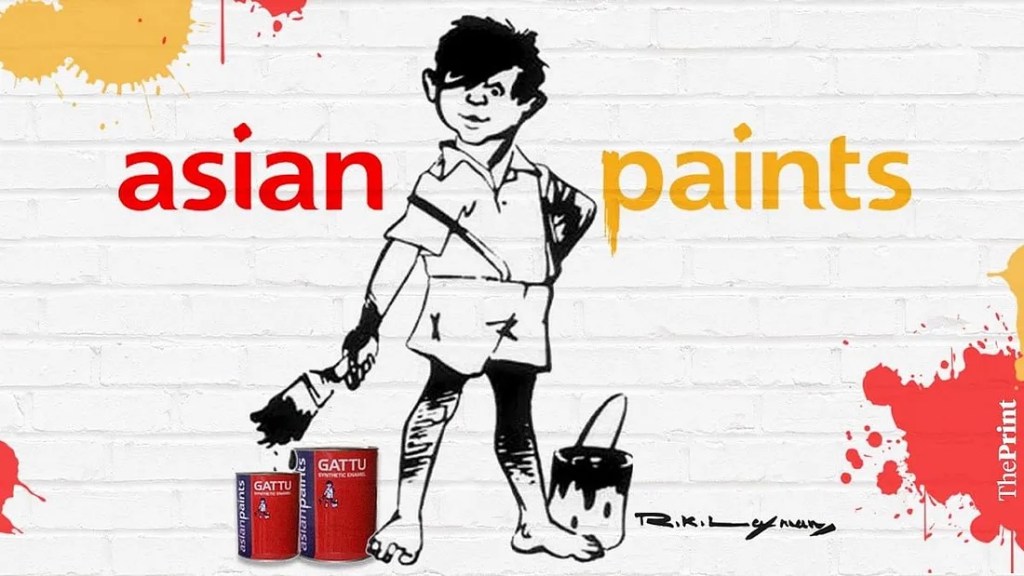
By the 1960s, their signature “Gattu” masco—a mischievous boy painted by the legendary cartoonist R.K. Laxman, became a familiar sight across India, symbolizing trust and approachability.
The Distribution Revolution (1970s-1990s)
As India’s economy liberalized in the 1991, global giants like Akzo Nobel (Deluxe) and Berger entered the market, expecting to dominate. But Asian Paints had built an impenetrable distribution fortress.
Here’s how they did it:
The Dealer Whisperers
Asian Paints treated its dealers like royalty. While competitors offered standard margins, Asian Paints provided higher commissions, free training, and inventory support.
Their “One Town One Dealer” policy prevented internal competition, ensuring loyalty. Today, they boast 70,000+ dealers—more than the combined network of their top three rivals.
2. The Rural Conquest
When other brands hesitated to venture beyond cities, Asian Paints set up “Utsav” vans that traveled to remote villages, offering on-the-spot colour mixing and demonstrations. They tapped into the aspirational dreams of rural India—where a freshly painted home signalled prosperity.
3. The Supply Chain Masterpiece
Asian Paints built 25 manufacturing plants across India and implemented a just-in-time delivery system that ensured no dealer ever ran out of stock. Their IT systems could track demand down to the taluka level, allowing hyper-local marketing.
By 1995, Asian Paints controlled 50% of India’s decorative paint market, leaving global players struggling to catch up.
The Psychology of Colour (2000s-Present)
Asian Paints didn’t just sell paint—it sold emotions, identity, and transformation.
The “Har Ghar Kuch Kehta Hai” Campaign
In the early 2000s, Asian Paints launched its iconic campaign linking wall colors to family stories. Ads showed:
A daughter painting her room purple to mark her independence.
A retired couple choosing serene blue for their peaceful new life.
This positioned Asian Paints as a silent narrator of Indian lives.
2. The Digital Metamorphosis
When competitors still relied on shade cards, Asian Paints launched:
“Visualizer” apps using AR to preview colors in your home.
“Where the Heart Is”—a Netflix-style docu-series on Indian homes.
– “AI-powered chatbots” for instant colour consultations.
3. The Premium Gambit
To combat Deluxe’s luxury appeal, Asian Paints introduced:
Royale Play: Textured finishes priced at ₹200/sq.ft.
Nilaya: A designer wallpaper range endorsed by celebrities.
AP Homes: End-to-end painting services with warranties.
The Competitors Who Couldn’t Keep Up
Nerolac: The Industrial Specialist
Kansai Nerolac focused on automotive and industrial paints, ceding the decorative market. Their ads lacked emotional pull, often featuring technical jargon.
Berger: The Late Bloomer
Despite innovative products like “Berger Express Painting,” their rural reach lagged. A failed JV with Paints & Coatings Ltd in 2013 set them back further.
Deluxe: The Premium Pretender
AkzoNobel’s Deluxe positioned itself as a “global premium brand,” but its ₹600/gallon price tag alienated middle India. Limited to metro showrooms, it became a niche player.
The Future—Storm Clouds or Clear Skies?
Threats on the Horizon
1. Grasim’s Entry: The Aditya Birla Group is investing ₹10,000 crore to challenge Asian Paints by 2025.
2. Regional Players: Indigo Paints’ IPO and JSW Paints’ aggression are chipping at margins.
3. DIY Disruption: Young homeowners now prefer paint-on-demand apps.
Asian Paints’ Counterattack
Acquisitions: Buying Weather-seal (2021) and Sleek (2023) to expand into waterproofing and modular kitchens.
Ecosystem Play: Launching “Beautiful Homes Stores” offering furniture and décor.
Sustainability Push: Water-based paints and zero-VOC formulas to attract eco-conscious buyers.
Epilogue: The Monopoly That Listens
What makes Asian Paints invincible isn’t just distribution or marketing—it’s their obsession with the Indian consumer. When Kerala homeowners complained about fungal growth, they developed “Apex Ultima” with anti-microbial properties. When North Indian winters cracked walls, they launched “Tractor Emulsion” for extreme weather.
In a nation where the average home is repainted every 5 years (vs. 8-10 years globally), Asian Paints has turned a functional product into an emotional ritual. As long as Indians associate fresh paint with new beginnings, Asian Paints will remain the brush that colors their dreams.

If you found this article valuable, please don’t forget to Like and Subscribe to my blog for more expert insights and updates.

 THE MIND UPGRADE
Leave a comment